
Cisco · short-links
Short-Reach Network Links: Choosing DAC, AOC or Separate Optics
Choose short-reach interconnects from endpoint support, routed distance, serviceability and complete installed cost.
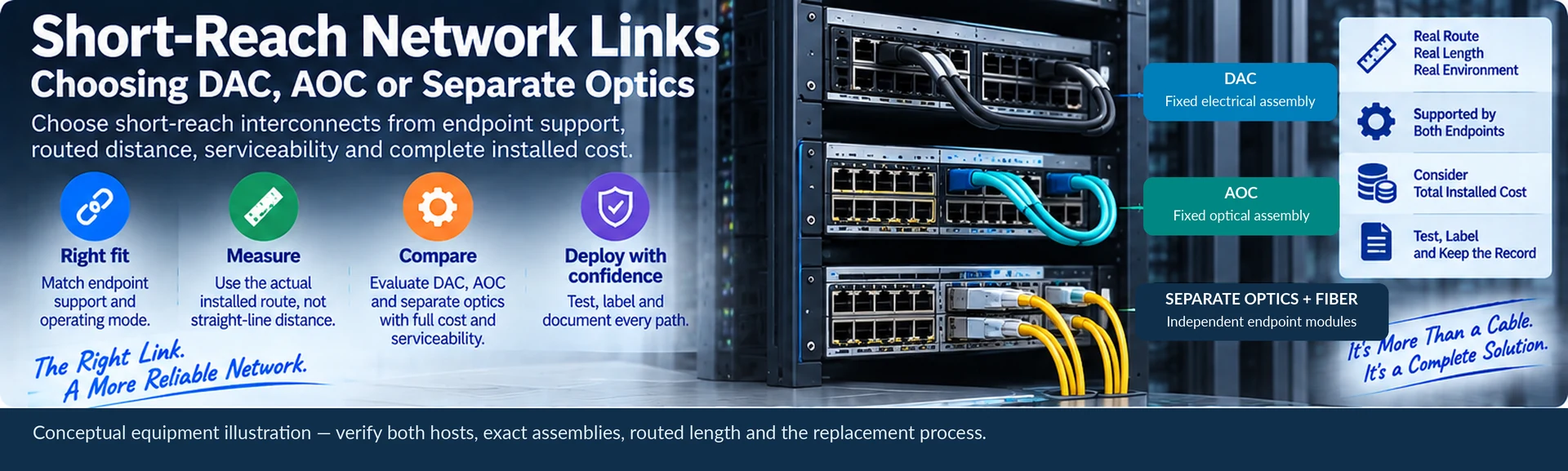
The shortest network connection is not always the simplest one to service. A rack-level interconnect must fit the host interfaces, route through the actual cable path and remain practical to replace. Compare DAC, AOC and separate transceivers with fiber as different installation choices—not as interchangeable products selected only by price.
Measure the installed route
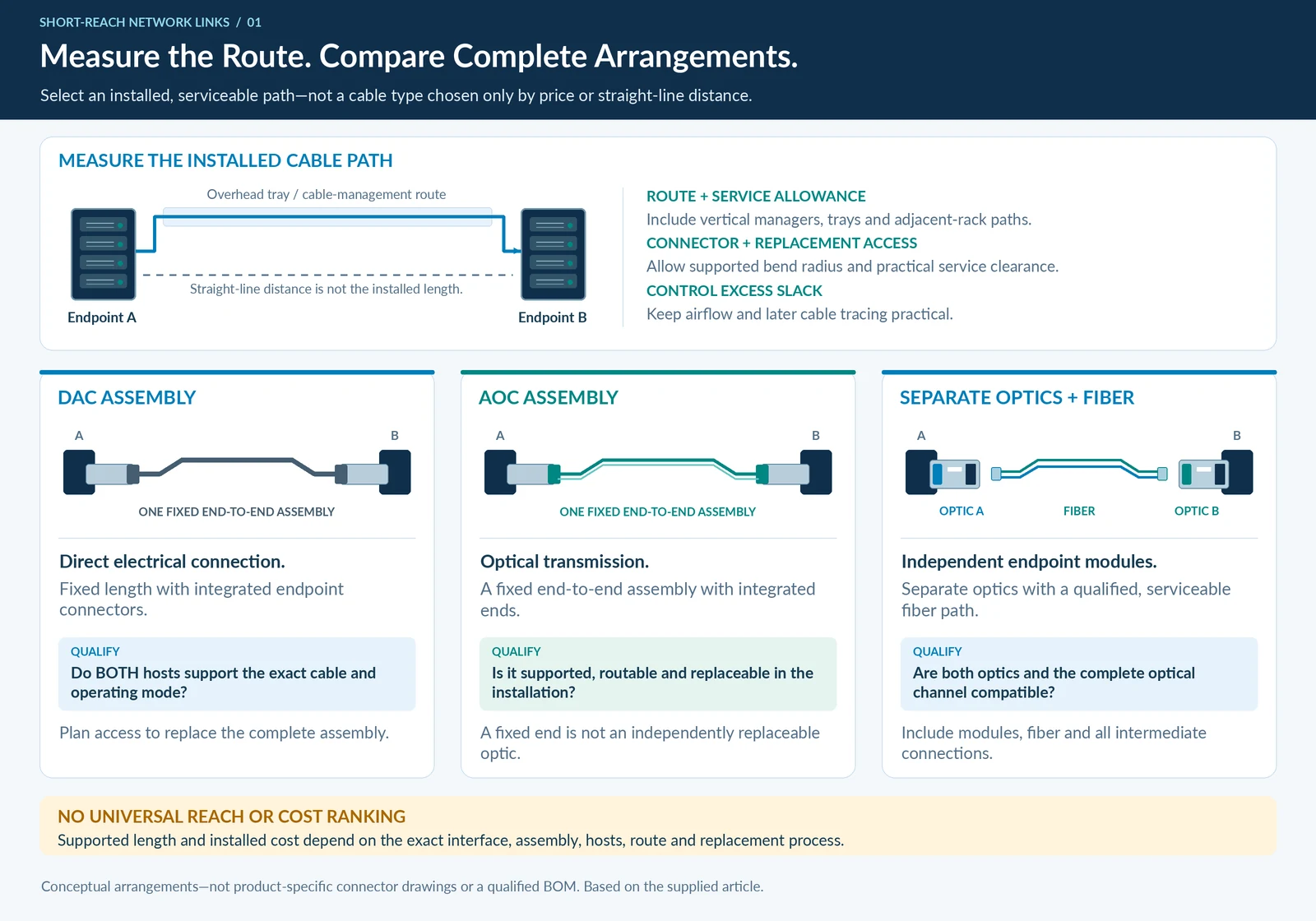
Use the cable path through vertical managers, overhead trays or adjacent racks, including the required service allowance. Straight-line distance between equipment faces can underestimate the assembly length. Excess slack can also obstruct airflow or make later tracing difficult.
Record connector access and replacement constraints. A fixed assembly passing through a crowded route may need more disruption to replace than separate modules and a structured fiber channel.
Compare complete arrangements
| Arrangement | Useful design consideration | Main qualification question |
|---|---|---|
| DAC assembly | Direct electrical connection with a fixed length and endpoint connectors | Do both hosts support this exact cable and operating mode? |
| AOC assembly | Optical transmission within a fixed end-to-end assembly | Is the assembly supported, routable and replaceable in this installation? |
| Separate optics and fiber | Independent endpoint modules with a serviceable fiber path | Are both optics and the complete optical channel compatible? |
Avoid universal distance cutoffs. Supported reach depends on the specific interface, cable implementation and host. Manufacturer transceiver and cable documentation distinguishes individual parts and modes. R18R25
Treat breakout as an interface design
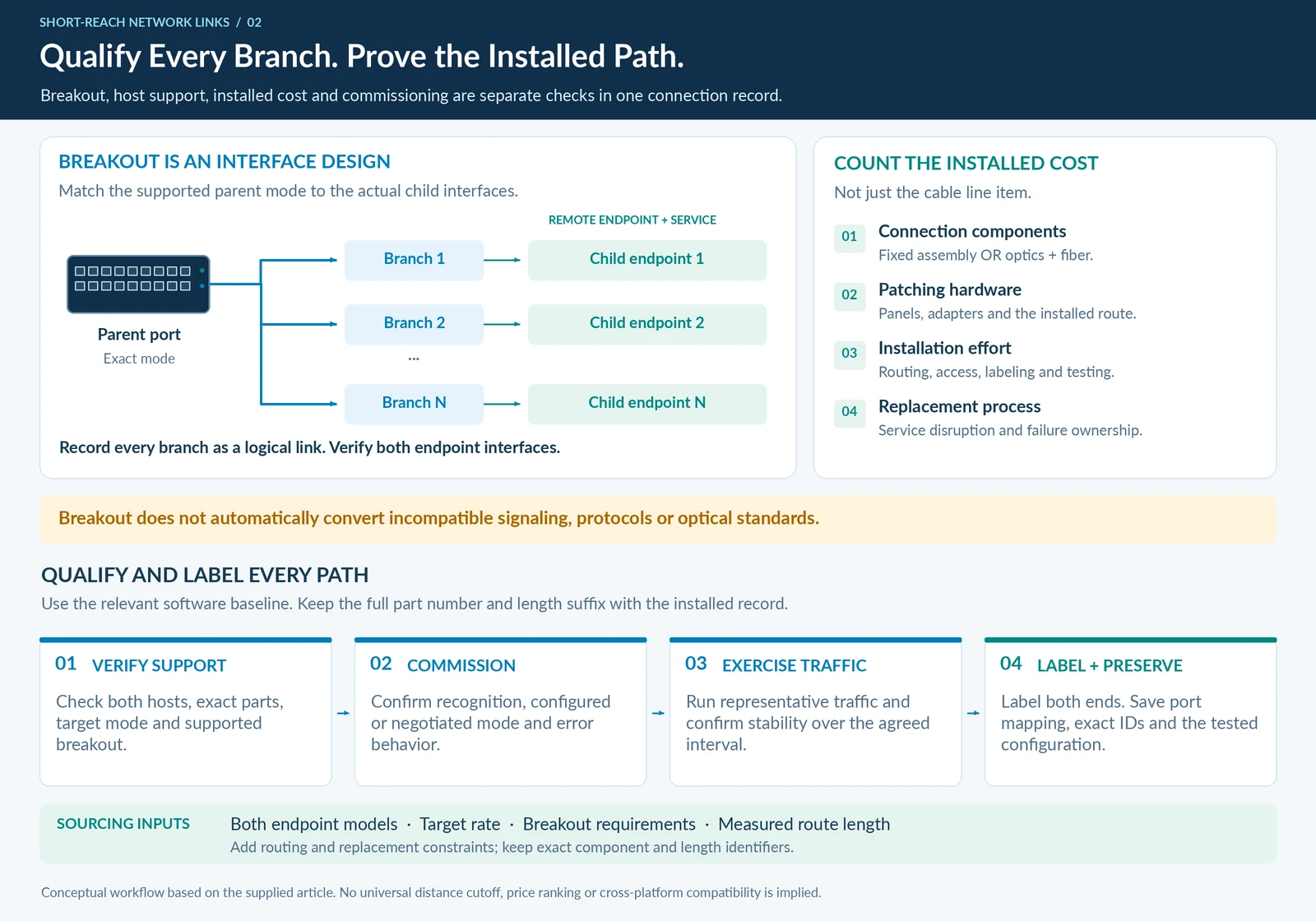
A breakout assembly must match the parent port’s supported mode and the child interfaces. It does not automatically convert incompatible signaling, protocols or optical standards. Record each branch as a logical link, including its remote endpoint and service role.
For an illustrative rack, six servers may be physically close enough for direct-attach assemblies, while two adjacent-rack servers require a structured route through a patching area. Selecting one cable type for all eight solely to simplify purchasing may increase service difficulty or produce an unsupported reach.
Compare installed cost rather than line-item price
Include endpoint modules where required, fiber or fixed assemblies, patching hardware, installation effort and the replacement process. Keep failure ownership clear: replacing one end of a fixed AOC is not the same operation as replacing an independent optic.
This comparison should remain project-specific. Without route and supplier information, no defensible claim can be made that one arrangement is always cheaper or more reliable.
Qualify and label every path
Check support at both hosts, including the relevant software baseline. Retain the exact part number and length suffix instead of shortening the description to “100G cable.” For separate optics, include module identifiers and the complete fiber specification. R49
During commissioning, verify recognition, negotiated or configured mode, error behavior and traffic stability. Label both ends against the port schedule and store the tested configuration with the record.
For a useful enquiry, provide both endpoint models, target rate, breakout requirements and measured route length. These inputs allow the interconnect to be selected as a deployable path rather than an isolated catalogue item.
Engineering illustrations
These figures illustrate the design concepts discussed here. They are not measured results, certified configurations or a supplied-equipment list.
Related reading
- 10G, 40G and 100G Short-Link Selection: DAC, AOC and SR-BD Checks
- Why a Cable-Length Suffix Can Change the Product You Are Buying