
AI & HPC networks
What must a server support before a ConnectX-7 400G upgrade?
Qualify the host slot, exact connector and current feature support before buying interconnects.
A 400G network port is only one side of a server upgrade. The adapter’s host interface, cooling and connector form can determine whether a proposed card is usable, and an auxiliary connection feature must be supported by the actual release.
The short answer
Freeze the exact OPN, protocol and connector, then qualify the server’s electrical slot and thermal support. Treat Socket Direct as an unresolved integration option until documentation and release support are reconciled for the offered card.
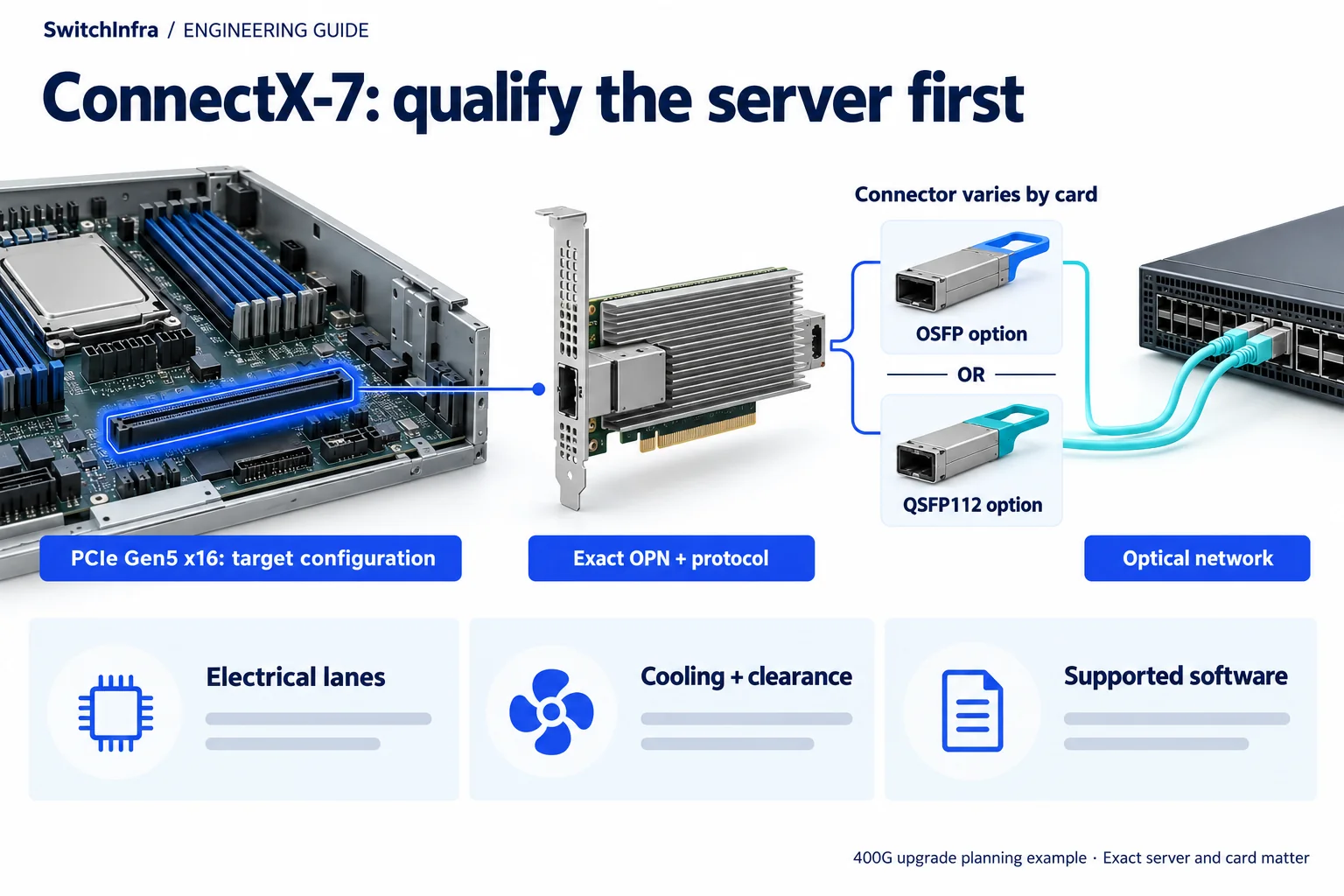
Plan the ConnectX-7 host slot, connector variant, thermal arrangement and supported software together. Conceptual illustration; equipment shapes are illustrative.
Official technical sources · Independent analysis by SwitchInfra
This is a documented design analysis, not a customer deployment claim. Candidate roles require verification for your configuration.
400G — target service example
Gen5 x16 — documented host configuration
OSFP / QSFP112 — different card interfaces
OPN-specific — feature qualification
What the technical reference establishes
NVIDIA documents stand-up ConnectX-7 cards with OSFP and QSFP112 interfaces and describes PCIe x16 configurations. The supported-interface page identifies MCX75310AAS-NEAT as OSFP and MCX715105AS-WEAT as single-port QSFP112.
The OSFP example maps to catalog code 900-9X766-003N-SQ0; the QSFP112 example to 900-9X7AH-0039-STZ. Listings do not validate the proposed server. Capture its riser, electrical slot and peer port before ordering.
ConnectX-7 introduction and host requirements
Connector — The manual lists different OSFP and QSFP112 cards.
Host — PCIe generation and wiring are configuration inputs.
Thermal — The manual requires adequate power and airflow.
Feature boundary — Socket Direct descriptions and current support notes require reconciliation.
Scope of the analysis: Independent selection analysis of official NVIDIA documentation. Proposed examples are not a deployed customer project or a SwitchInfra delivery.
Work through the engineering choices
Start with the documented constraint, then state the conditions for the proposed equipment role.
Start with the exact connector and protocol
The family contains distinct card forms and protocol capabilities.
Design exercise: Proposed task: compare an OSFP offer with a QSFP112 offer for the same server.
The two offers may need different modules or cable terminations even when the service rate matches. Record the full OPN and protocol support rather than assuming that every ConnectX-7 card can serve both Ethernet and InfiniBand. Confirm the required port personality and peer configuration.
Check the cage’s cooling arrangement and the supported module power. Do not force a switch-side twin-port assembly into an adapter role. Ask the supplier for the complete endpoint pairing and identify which components are included, so the quotation cannot hide a missing or unsuitable termination.
ConnectX-7 introduction and host requirements · ConnectX-7 supported interfaces
Single-port OSFP card inquiry
Catalog order code 900-9X766-003N-SQ0. Exact rate, protocol and host configuration require OPN-level review.
Single-port QSFP112 card inquiry
Catalog order code 900-9X7AH-0039-STZ. Distinct connector and integration; do not substitute by family name.
Qualify electrical bandwidth and thermal integration
The manual documents PCIe x16 system requirements.
Design exercise: Proposed task: verify the populated server’s slot rather than an empty chassis specification.
Obtain the actual riser and slot map, including electrical width, generation and any shared resources. A mechanically compatible slot does not establish the host bandwidth available to the application. Define the expected traffic and test the complete host path, not only the remote network link.
Review server approval, available power, airflow and neighboring accelerators. Include the intended optics in the thermal assessment because their dissipation is part of the endpoint. Retain the tested firmware, driver and host settings with the results so that a later substitution can be evaluated against the same baseline.
ConnectX-7 specifications · ConnectX-7 introduction and host requirements
Resolve auxiliary-link support before ordering it
The introduction describes Socket Direct; the interface page marks some support unavailable.
Design exercise: Procurement boundary: do not assume a populated auxiliary connector proves a supported feature.
The supported-interface page currently marks Socket Direct unsupported for MCX755106AC-HEAT, MCX755106AS-HEAT, MCX75510AAS-HEAT and MCX75510AAS-NEAT, although other sections describe the architecture. Resolve support for the exact release and OPN in writing; auxiliary connectors do not establish a deliverable feature.
If an approved configuration is established, request its exact auxiliary kit, harness length, slot assignment and software requirements. Otherwise quote the reviewed standalone configuration. Describe the resulting host limitation honestly and validate it with the intended workload instead of silently substituting an unqualified connection arrangement.
ConnectX-7 supported interfaces · ConnectX-7 introduction and host requirements
ConnectX-7 Socket Direct auxiliary kit
Host-integration inquiry
Not a verified supported offer; reconcile OPN and current release restrictions.
Compare complete endpoint configurations
A meaningful quotation includes the adapter, its host integration and the exact remote channel. Module shape, nominal rate and a visible connector cannot establish the complete supported path.
ConnectX-7 introduction and host requirements
Identity
OPN, protocol, connector, firmware and supported port configuration.
Host
Server approval, electrical slot, power, airflow and tested workload.
Auxiliary option
Written feature support, exact kit and physical slot mapping if approved.
Candidate models and selection boundaries
These are conditional model or product-family inquiries for the documented equipment roles. Confirm the required rate and complete channel before finalizing any line.
| Model / family and status | Role and condition |
|---|---|
| MCX75310AAS-NEAT Catalog SKU: 900-9X766-003N-SQ0 Listed model; conditional candidate | Single-port OSFP card inquiry Catalog order code 900-9X766-003N-SQ0. Exact rate, protocol and host configuration require OPN-level review. ConnectX-7 supported interfaces · ConnectX-7 introduction and host requirements |
| MCX715105AS-WEAT Catalog SKU: 900-9X7AH-0039-STZ Listed model; conditional candidate | Single-port QSFP112 card inquiry Catalog order code 900-9X7AH-0039-STZ. Distinct connector and integration; do not substitute by family name. ConnectX-7 supported interfaces |
| ConnectX-7 Socket Direct auxiliary kit Excluded for this role | Host-integration inquiry Not a verified supported offer; reconcile OPN and current release restrictions. ConnectX-7 supported interfaces · ConnectX-7 introduction and host requirements |
Rows with product IDs are mapped to the exact listed model or ordering variant checked on 19 October 2026. Remaining rows are model or family inquiries. A public listing does not establish stock, offered condition, supply or project compatibility.
Continue in the relevant product family
Use the analysis to define the role before comparing catalog options.
Discuss this project
Carry the route, media, endpoint and loss requirements into the inquiry. Leave unknown quantities blank; reference port and fiber counts are not an equipment BOM.
Follow the next selection question.
Compare related decisions while keeping each source’s scope, hardware and link conditions separate.
Browse more engineering analyses →
400G to 200G: qualify every optical branch
Check lane generation, shared split mode and complete PMD before ordering fiber fanout.
Read the engineering analysisOfficial technical source
H100 SuperPOD: four fabrics, four connection schedules
Keep compute, storage, service access and OOB management distinct before counting equipment.
Read the engineering analysisOfficial technical source
HGX Spectrum-X: separate SuperNIC and DPU duties
Keep GPU communication, converged services and management distinct in the node and fabric BOM.
Read the engineering analysisOfficial technical source
Before you finalize the channel
Can OSFP and QSFP112 offers share the same plug?
Do not infer that. They are distinct physical interfaces.
Does Gen5 x16 remove every application bottleneck?
No. The complete server, application and fabric require assessment.
Does an auxiliary socket prove Socket Direct support?
No. Resolve the current OPN and release restrictions first.
Is the example a verified SwitchInfra configuration?
The two card listings are mapped; offered configuration and server compatibility remain unconfirmed.
Trace the project facts and technical limits
- ConnectX-7 introduction and host requirements
- ConnectX-7 supported interfaces
- ConnectX-7 specifications
Source check: 19 October 2026. Catalog status is stated per candidate.
Official sources read 19 October 2026. Project-specific engineering review, firmware support, exact offered parts and supply remain unconfirmed.