
Data Center & AI
Q3200-RA XDR Rollout with Existing NDR Storage: A 12-Server Design
Use a worked Q3200-RA and Q3400-RA port budget, qualify NDR storage paths by cage and cable, and stage acceptance before changing production.
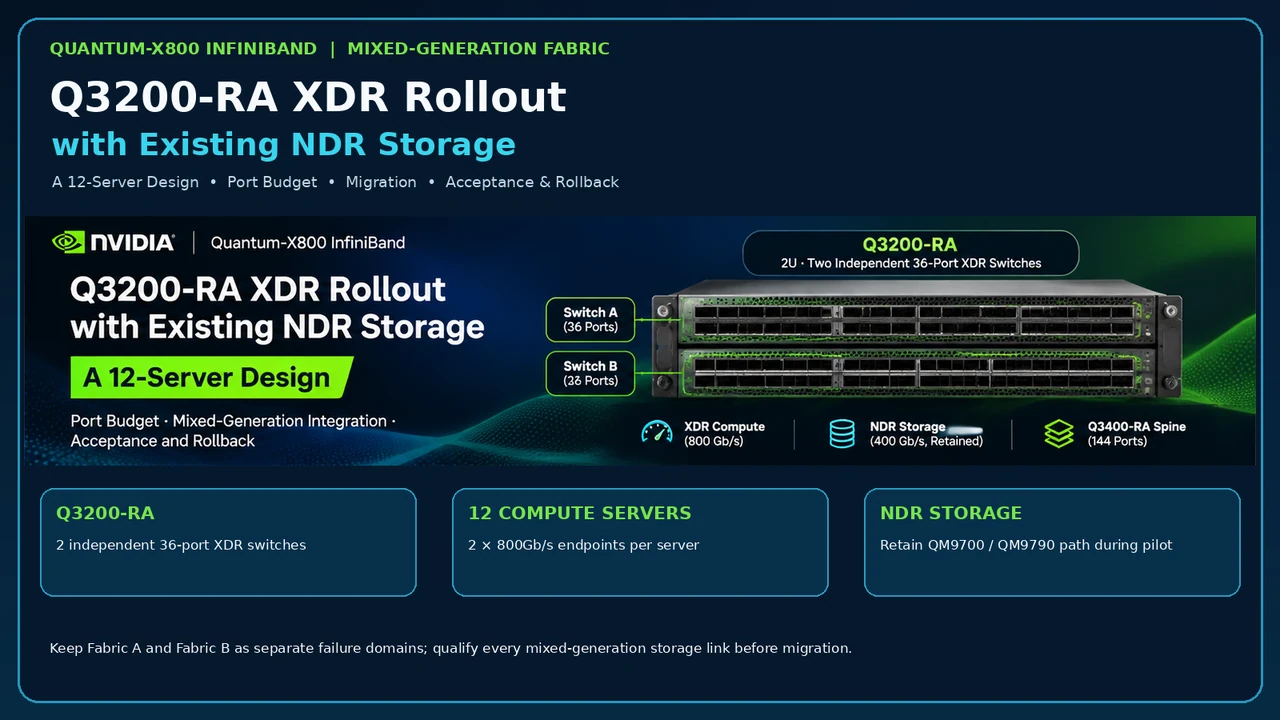
A Q3200-RA chassis has two independent 36-port eXtreme Data Rate (XDR) InfiniBand switches. Build a port schedule for each internal switch and a failure plan for the enclosing 2U system. To add new XDR compute while keeping NDR storage, treat the retained NDR path as an explicit migration workstream. Validate each planned XDR-to-NDR connection and its exact cage, rate and media before moving storage traffic. NVIDIA NVOS Q3200 design considerations · NVIDIA Q3200 cable installation and port map
The migration overview shows how to add XDR compute links while keeping the existing NDR storage paths available. View full-size cover image.
Reference application: Q3200 leaf and Q3400 spine in a mixed fabric
NVIDIA’s NVOS design appendix shows Q3200 in the leaf position with XDR uplinks to a Q3400 spine and XDR400 or NDR connections toward the servers. It also describes integrating earlier-generation InfiniBand storage into a newer fabric. Use that architecture to define which links stay at NDR and which use XDR. The 12-server example below uses a separately stated port allocation and its own failure domains. NVIDIA NVOS mixed-generation Q3200 design appendix
In another published architecture, the DGX B300 XDR SuperPOD names Q3400-RA for its compute fabric. That is a separate reference for 144-port spine-scale switching. In a retrofit, qualify existing storage attachments and the proposed new compute rail independently. NVIDIA DGX B300 XDR switch roles
Worked port budget for independent chassis
Assume 12 new compute servers each have two qualified 800 Gb/s InfiniBand endpoints, one per fabric. Assume two Q3200-RA systems are in separate failure domains, one active internal switch per chassis for this pilot, and each fabric has its own Q3400-RA upstream switch. Neither unused internal switch is counted in the pilot capacity. The 1:1 ratio below uses the sum of link rates in one direction and excludes any NDR storage links.
| Block | Per fabric | Across both fabrics |
|---|---|---|
| XDR host links into the active Q3200 internal switch | 12 × 800 Gb/s | 24 links |
| XDR uplinks to the same fabric’s Q3400-RA | 12 × 800 Gb/s | 24 links |
| Logical data ports used on the active internal switch | 24 out of 36 | 48 used across the two active switch instances |
| Unallocated logical data ports on the active internal switch | 12 | 24 on the two active instances |
| Nominal downlink and uplink capacity | 9.6 Tb/s on each side of the switch in the port-budget calculation | Capacity remains separate by fabric |
On each Q3200 instance, 24 logical links consume at least 12 data cages if qualified twin-port assemblies populate both positions. Different endpoint optics, cooler types, patch-panel layouts or reserved cage positions can require more cages. Use the vendor’s A/B port notation and keep chassis, ASIC, cage and logical port on every line of the schedule. Add the fabric management link separately. NVIDIA Q32xx/Q34xx introduction · NVIDIA Q3200/3400 cable installation
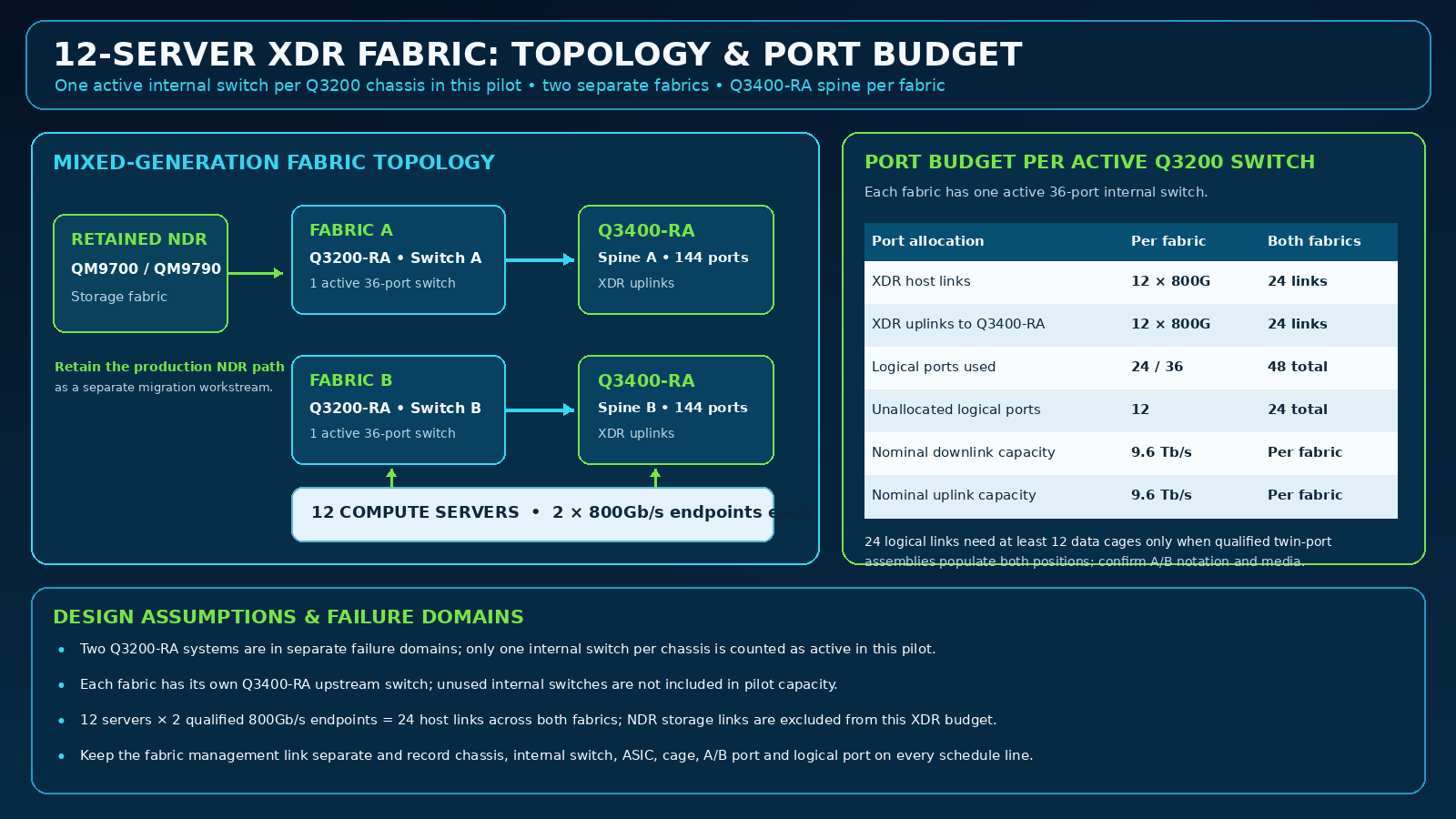
Use the diagram to trace the server connections, switch port allocation and retained storage links.
Compare the switches at the migration boundary
| Model pair | Deployment decision |
|---|---|
| Q3200-RA leaf vs Q3400-RA spine | Use 36 ports per active Q3200 instance for host and uplink allocation. Count the 144-port Q3400 domain independently as the spine and map both optical ends. |
| Q3200-RA vs retained QM9700 | Keep the existing managed NDR storage service if acceptance requires continuity. Use the Q3200 for the documented mixed-generation link, confirming the exact cage and configured NDR or XDR rate. |
| Q3200-RA vs retained QM9790 | Apply the same physical compatibility review and leave the external subnet manager path in the migration test. Record who owns visibility and recovery of the QM9790 fabric. |
| Q3400-RA vs Q3401-RD | Preserve the spine’s logical port budget if the design requires that 144-port class. Change the rack plan from AC to the documented 48V DC busbar before specifying Q3401-RD. |
NVIDIA XDR ordering and cable scope · NVIDIA Quantum-2 QM97XX ordering and management
Keep NDR storage steady during the rollout
- Record the current state. Inventory the QM9700 or QM9790 pair, storage endpoints, configured link speeds, current paths and measured storage performance. Capture UFM and subnet management ownership. Retain the existing production paths while the XDR compute links are qualified.
- Qualify a representative coexistence link. Map its endpoint, firmware, exact XDR switch cage, NDR link mode, splitter and branch. NVIDIA excludes the MCA4J80, MCA7J60 and MCA7J70 NDR cable families from Q3200-RA positions A17–A18 and B17–B18. Check the port-mode and media guidance before placing even one of those assemblies. If the application needs a separate storage fabric, keep the two endpoint schedules distinct.
- Test the rollback path. Add a pilot set of storage traffic and compare negotiated rate, counters, errors and real read/write behavior against the original route. Rehearse loss of the intended links or fabric under controlled conditions. Preserve the old attachment and a signed procedure for restoring it until the pilot meets the agreed targets. NVIDIA Q3200 cable limitations and port notation
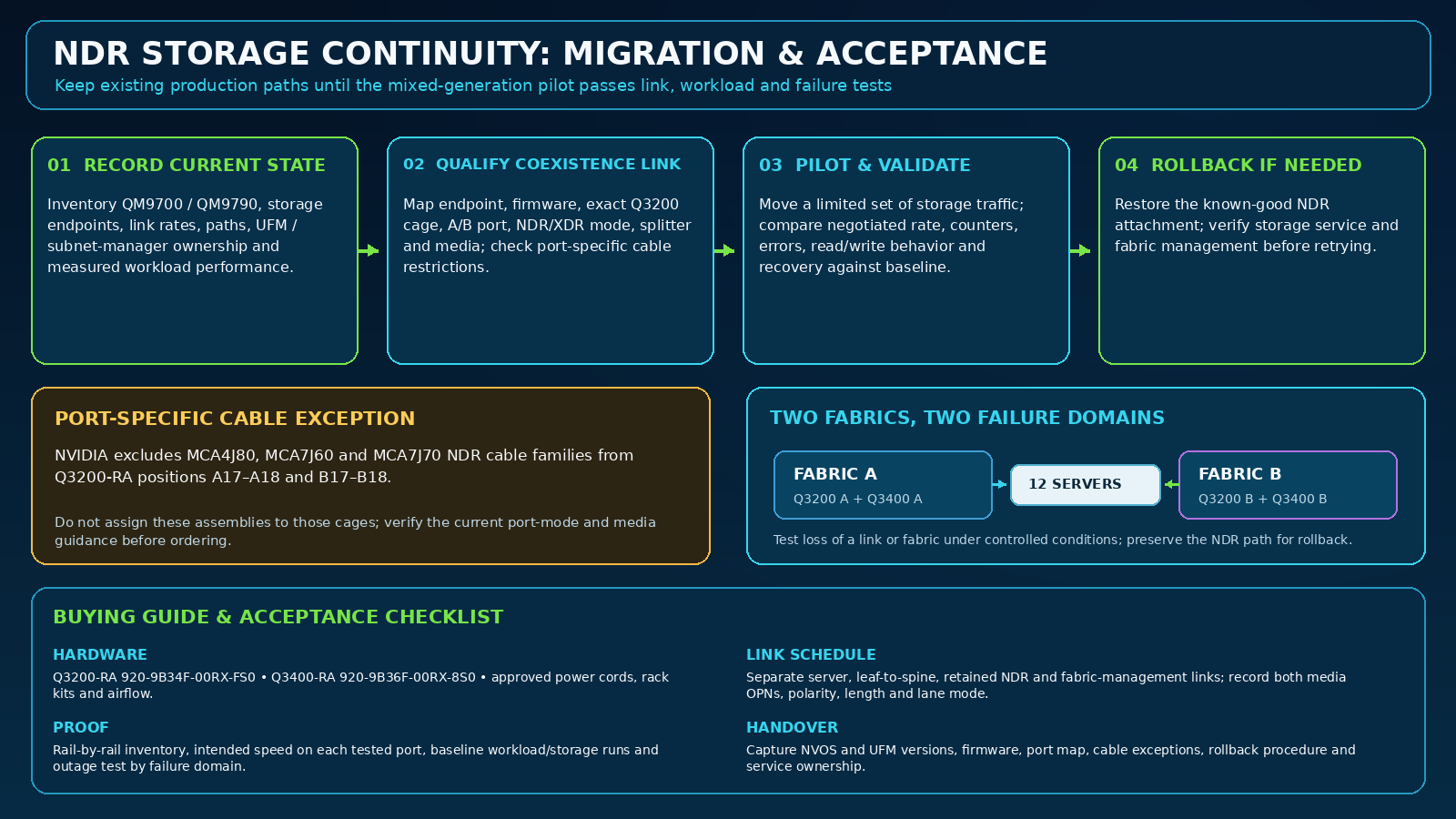
Check storage access and rollback readiness at each stage of the compute fabric migration.
Replacement decision and verification
Replacement decision. Apply the Q3200 as a qualified mixed-generation leaf or edge attachment. Keep the existing NDR storage switch and its control path when the project scope is a compute rollout with storage continuity. If the spine choice changes to Q3401-RD, qualify its DC rack before releasing the otherwise similar port-count plan. NVIDIA NVOS mixed-generation example · NVIDIA XDR order rows
Acceptance and rollback. Move a limited set of storage paths first and check the documented link mode, expected counter behavior and storage service from a compute host. If the agreed service or recovery target fails, restore the known-good NDR attachment and verify storage and fabric management from the original baseline before retrying.
Buying guide and acceptance checklist
- Hardware. 920-9B34F-00RX-FS0 for the Q3200-RA and 920-9B36F-00RX-8S0 for the Q3400-RA in this example. Quote approved power cords, rack kits and the appropriate airflow with the switches. Retain exact part numbers for NDR chassis and spares.
- Link schedule. Distinguish server, leaf-to-spine, retained NDR, and InfiniBand fabric management links. Record both media part numbers, connector polarity, route length, lane mode and current support reference for every link type. Quote quantities from cages and assemblies after the logical map is approved.
- Proof. Require rail-by-rail inventory, the intended speed on every tested port, baseline workload and storage runs, and an outage test aligned with physical fault domains. Capture firmware, NVOS and UFM versions in the handover.
Use the figures above to scope a review, then provide the host OPNs and planned storage attachment to build the orderable bill of materials. NVIDIA tested Quantum-X800 hardware and interconnects · SwitchInfra XDR fabric planning
Frequently asked questions
Which count do I use when I buy media for the mixed-generation leaf?
Count each logical server and spine link, then map it to its physical cage and approved assembly. Include the allowed NDR or XDR rate and the cable restriction for the assigned ports. Use the resulting cage and branch schedule to count modules. NVIDIA Q3200 cable installation and exceptions
How do I prove that the retained storage path survives the change?
Record the current workload and storage path, retain an approved rollback attachment, and compare the production-representative workload on the pilot. Test loss of the intended link or fabric. Include storage application behavior and subnet management in the pass criteria. NVIDIA NVOS Q3200 design appendix
Acronyms and terms
- XDR means eXtreme Data Rate, the 800 Gb/s InfiniBand generation in this design. NDR means Next Data Rate, the 400 Gb/s generation.
- OSFP means Octal Small Form Factor Pluggable. ASIC means application-specific integrated circuit.
- NVOS is NVIDIA’s network operating system. UFM means Unified Fabric Manager.
- BOM means bill of materials. A rail here is a fabric path or plane with its own topology and failure budget.