
Data centers
What does an OM5 data-center trunk allow—and what must the optics still prove?
Keep duplex wavelength multiplexing, parallel optics and rack density distinct in the selection.
OM5 supplies a multimode physical foundation. It does not select a transmission method, validate a switch port or establish the speed of an installed link.
The short answer
Choose the optical PMD first for the actual service and endpoints, then verify its fiber mapping and loss budget. Treat SWDM and parallel optics as different options requiring different channels.
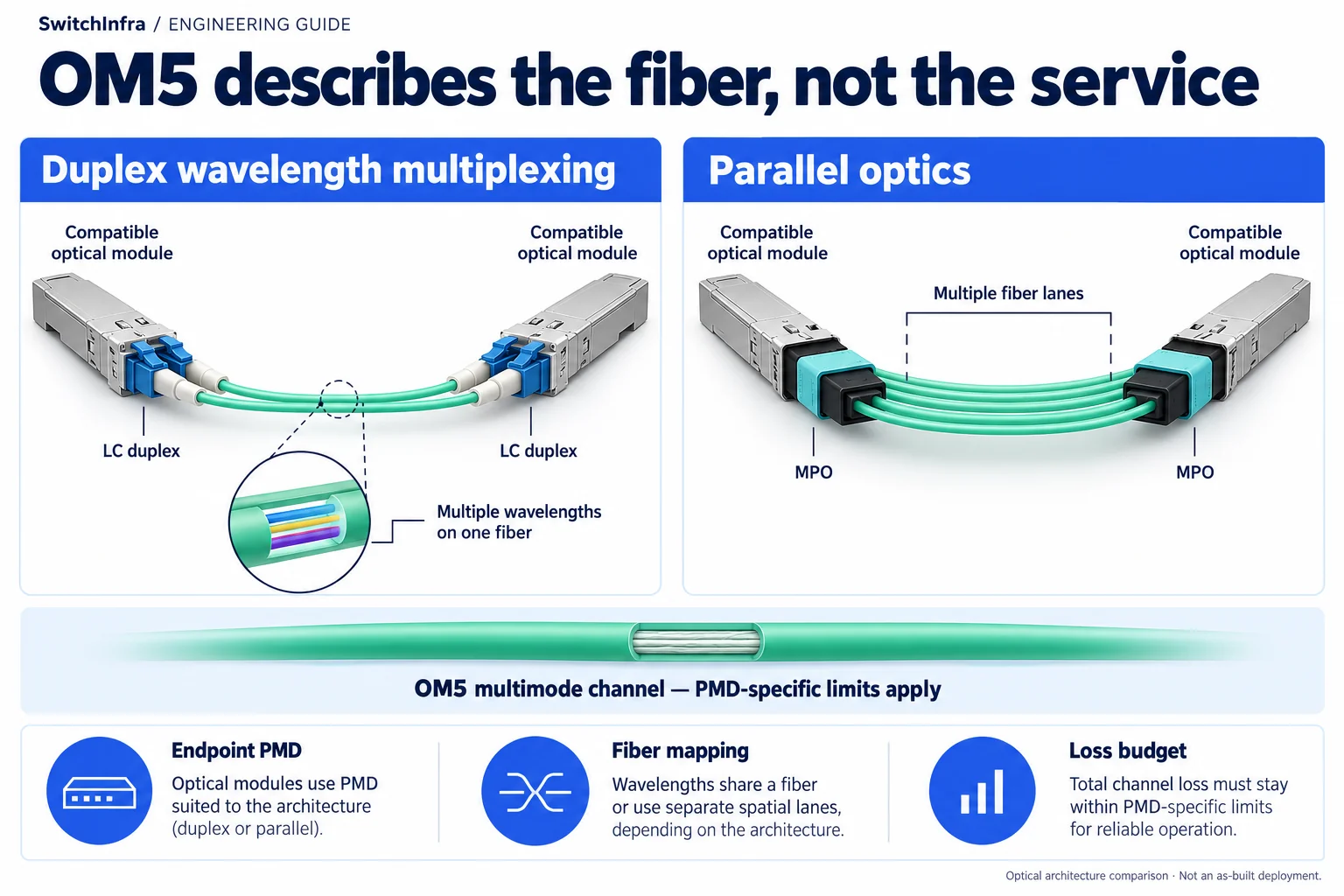
OM5 describes the fiber medium. The optical PMD determines wavelength use, spatial lanes, mapping and the channel limits. Conceptual illustration; equipment shapes are illustrative.
Third-party project account · Independent analysis by SwitchInfra
Not a SwitchInfra deployment. Candidate equipment is proposed for comparable requirements.
OM5 — reported preterminated trunks
MTP — reported low-loss connectors
96 / 144 fibers — supplier-recommended 1U options
Unknown — installed optical PMDs
What the documented project tells us
iCONEC describes OM5 preterminated trunks with MTP low-loss connectors at China Railway’s phase-two data center. It also reports Cat 6 copper cabling and recommends different fiber-distribution densities for different areas.
The useful selection problem is deciding what an OM5 label does and does not settle. The account mentions shortwave wavelength division and parallel transmission, but does not identify the actual active equipment or optical configuration.
iCONEC, republished by Qianjia project account
Media — OM5 multimode trunks are described for the machine room.
Termination — The supplier reports low-loss MTP connectors.
Density — It recommends 1U 96-fiber and 144-fiber distribution options.
Copper — Cat 6 unshielded cabling is also reported.
Scope of the analysis: Public project analysis of a third-party supplier account. Not a SwitchInfra deployment or independent acceptance report. Every proposed rate and model below is a separate design exercise.
Work through the engineering choices
Start with the documented constraint, then state the conditions for the proposed equipment role.
Separate wavelength multiplexing from parallel lanes
The account discusses SWDM and parallel transmission approaches.
Design exercise: Design exercise: compare two optical approaches for an independently specified service.
A duplex wavelength-multiplexed path and a parallel multifiber path can use the same broad fiber category while needing different endpoint interfaces and fiber assignments. Specify the intended PMD, not simply an OM5-compatible module. Verify both endpoints support that exact application.
Do not promise additional reach merely because OM5 supports a wider wavelength range. For a conventional 850 nm SR4 example, use the exact vendor’s OM5 specification and channel limit. Improvements associated with another optical method cannot be transferred to SR4 by changing the cable label.
Cisco 40G optical module data sheet
Match the MTP path to the port mode
The source reports preterminated MTP trunks without an equipment map.
Design exercise: a native 40GBASE-SR4 connection.
QSFP-40G-SR4-S is a native 40G candidate on a verified suitable multimode channel. Its parallel interface needs the correct MPO mating, lane ordering and complete fiber continuity. A cassette presenting duplex LC is not itself a direct SR4 interface.
If four 10G endpoints are proposed, the non-S QSFP-40G-SR4 may be assessed with supported host breakout and a verified harness. The S-class SR4-S lacks this mode. This is a separate design decision, and the original railway account proves neither arrangement.
Cisco 40G optical module data sheet · CommScope cassette and distribution reference
Quote density together with service capacity
The supplier recommends different 1U fiber capacities.
Design exercise: Design exercise: compare distribution options for a new row.
Start with the number of complete channels and their fibers per service. Add reserved capacity and working clearance. A 144-fiber panel does not provide 144 duplex links; parallel services may consume more than one pair, and some positions may be reserved or inaccessible through the chosen assemblies.
SFP-10G-SR is a conditional duplex 10G option for a separate multimode access requirement. Price the correct cassettes or adapter panels, jumpers and optics as one channel. Compare maintainability and measured loss alongside occupied rack units, rather than choosing the densest faceplate alone.
Cisco 10G optical module data sheet · CommScope cassette and distribution reference
Ask for the PMD and channel schedule in one response
For each service, the RFQ should state its transmission method, physical mapping and endpoint mode. Ask the reviewer to identify any change of cassette, harness or software needed to make the proposed combination work.
Cisco optics compatibility matrix
PMD
Rate, duplex or parallel operation, and exact endpoint optical PIDs.
Distribution
Fiber consumption, mapping, connector mating and service access.
Budget
Measured path loss, vendor limits and the proposed port configuration.
Candidate models and selection boundaries
These are illustrative model inquiries, not the equipment installed in the source project. Confirm the required rate and complete channel before finalizing any line.
| Model / family and status | Role and condition |
|---|---|
| QSFP-40G-SR4-S Conditional model inquiry | Independent native 40G example OM5 does not confer breakout support; verify channel. Cisco 40G optical module data sheet |
| QSFP-40G-SR4 Conditional model inquiry | Conditional 40G or breakout option Exact host mode, harness and reach require review. Cisco 40G optical module data sheet |
| SFP-10G-SR Conditional model inquiry | Separate duplex 10G MMF example LC channel; not a substitute for a parallel PMD. Cisco 10G optical module data sheet |
Listed models are independent design candidates, not equipment identified in this project. IDs are supplied only for previously verified exact catalog matches. Other PIDs are model inquiries; supply and platform compatibility are unconfirmed.
Continue in the relevant product family
Use the analysis to define the role before comparing catalog options.
Discuss this project
Carry the route, media, endpoint and loss requirements into the inquiry. Leave unknown quantities blank; source-project fiber counts are not an equipment BOM.
Follow the next selection question.
Compare related decisions while keeping each source’s scope, hardware and link conditions separate.
Browse more engineering analyses →
Single-mode university data center: 100G / 40G selection
A G.657.A2 fiber plant makes the complete optical channel central to the equipment choice.
Read the engineering analysis · Original project account
Expand mixed OM4 and single-mode cabling
A public Xi’an expansion account becomes a practical guide to channel allocation, 1U fiber density and patching-loss budgets.
Read the engineering analysis · Original project account
Building interconnect: pretermination or splicing?
Compare complete installation, mapping and acceptance packages at high fiber counts.
Read the engineering analysis · Original project account
Before you finalize the channel
Does OM5 prove 100G or 400G was deployed?
No. Cable capability and supplier migration statements do not establish installed link rates or tested performance.
Is any MTP trunk suitable for SR4?
No. Check fiber grade, fiber count, mapping, polarity, mating and the complete loss budget.
Can SR4-S provide four 10G connections?
No. Evaluate the non-S model only with a supported host and a correctly mapped breakout channel.
Are 96-fiber and 144-fiber panels interchangeable BOM rows?
No. Capacity, cassette arrangement, accessibility and channel loss must be evaluated for the specific service schedule.
Trace the project facts and technical limits
- iCONEC, republished by Qianjia project account
- Cisco 40G optical module data sheet
- CommScope cassette and distribution reference
- Cisco 10G optical module data sheet
- Cisco optics compatibility matrix
Source check: 19 October 2026. Catalog status is stated per candidate.
Sources checked 19 October 2026. Supplier density recommendations are not verified installed counts. No active optical configuration or independent performance report was obtained.