
Data Center & AI
SN5610 800GbE RoCE Leaf-Spine Design: Port, Optics and Power BOM
Work through a two-leaf Spectrum-4 RoCE design using SN5610, including 800GbE port allocation, one-spine failure, media qualification and AC power.
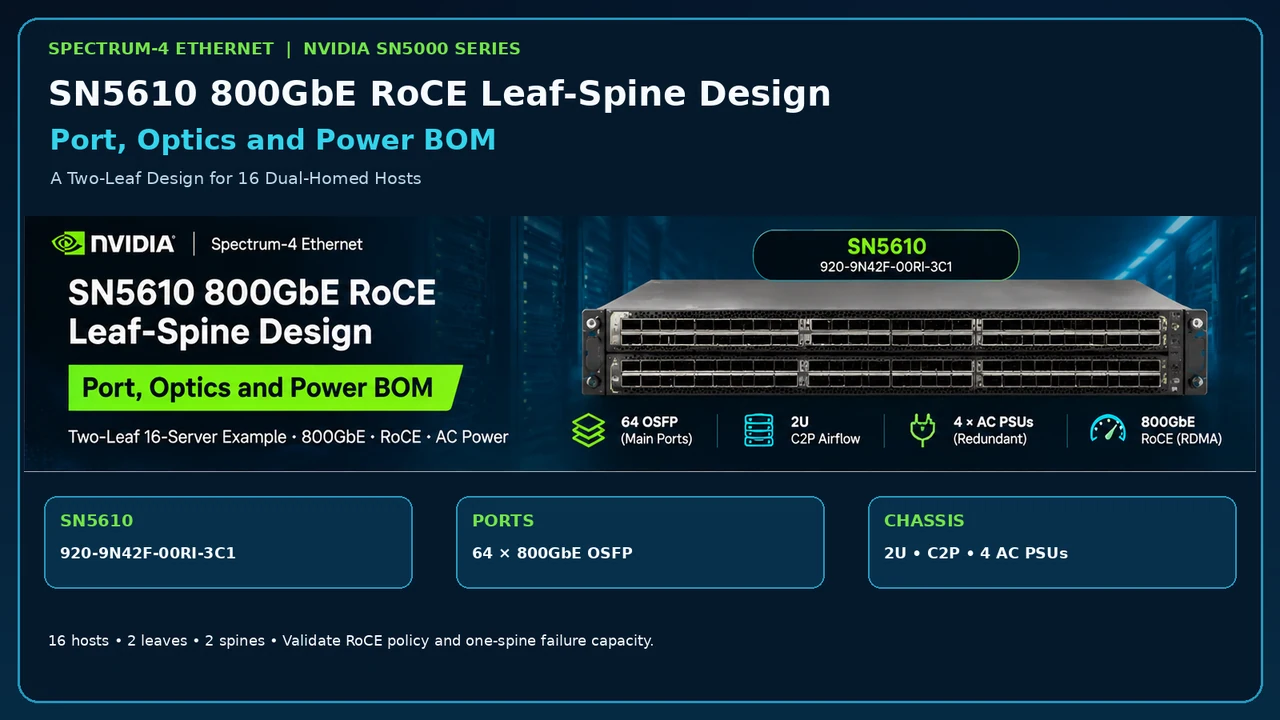
The NVIDIA SN5610 920-9N42F-00RI-3C1 is a 2U, C2P Spectrum-4 Ethernet switch with 64 main OSFP cages and four AC power supplies. A 16-port host block with 16 same-rate 800GbE uplinks fits in 32 main cages per leaf. The qualified bill of materials also needs compatible endpoint modes, a power plan for failure conditions, and the traffic policy for Remote Direct Memory Access (RDMA) over Converged Ethernet (RoCE). NVIDIA SN5000 ordering information · NVIDIA SN5610 specifications
Plan the leaf and spine roles, port allocation, optics and power for the SN5610 fabric. View full-size cover image.
Documented application: an engineered SN5610 Ethernet fabric
NVIDIA’s HGX AI Factory reference architecture names SN5610 for compute, customer-facing storage and in-band management roles. Dell publishes a separate proof of concept for AI Ethernet using PowerSwitch SN5610 and Dell SONiC, including a distinct SN2201 out-of-band path. These sources describe a vendor architecture and a lab validation, respectively. The acceptance plan here uses NVIDIA’s exact order and the selected firmware and network operating system for the proposed installation. NVIDIA HGX AI Factory networking hardware · Dell SN5610 AI fabric proof of concept
When adapting that design, the operator needs separate link schedules for compute, storage and out-of-band management. Qualify the installed host’s native 800GbE presentation or its documented 400GbE branches. The following 16-host design is a worked sizing example with qualified native 800GbE peer links. Its calculated capacity is separate from Dell’s test environment.
A two-leaf launch block for 16 dual-homed hosts
Assume each host presents one qualified native 800GbE link to each leaf. Each leaf sends eight 800GbE links to Spine 1 and eight to Spine 2. The plan uses one physical main cage per link on the leaf and assumes each spine supports the required native port mode and corresponding media.
| Item | Per SN5610 leaf | Two-leaf total or shared requirement |
|---|---|---|
| Host-side Ethernet links | 16 | 32 links across 16 dual-homed hosts |
| Uplinks to the spine pair | 8 to each spine, 16 total | 32 leaf-to-spine links, 16 terminating at each spine |
| Main OSFP cages used at the leaf | 32 of 64 | 64 leaf cage positions used |
| Nominal host-side and uplink rate | 12.8 Tb/s each across assigned links | Plan service capacity and host traffic distribution separately |
| Nominal uplink rate if one spine is lost | 6.4 Tb/s | 2:1 host-side to surviving uplink capacity per leaf under the original host load |
These calculations sum advertised line rates in one direction. Record how the host software uses both links, how flows distribute across the spines, and the throughput required during a spine or leaf outage. Reserve separate management paths. Avoid counting the two SFP28 interfaces as additional 800GbE paths. NVIDIA SN5000 introduction, SN5610 interface table
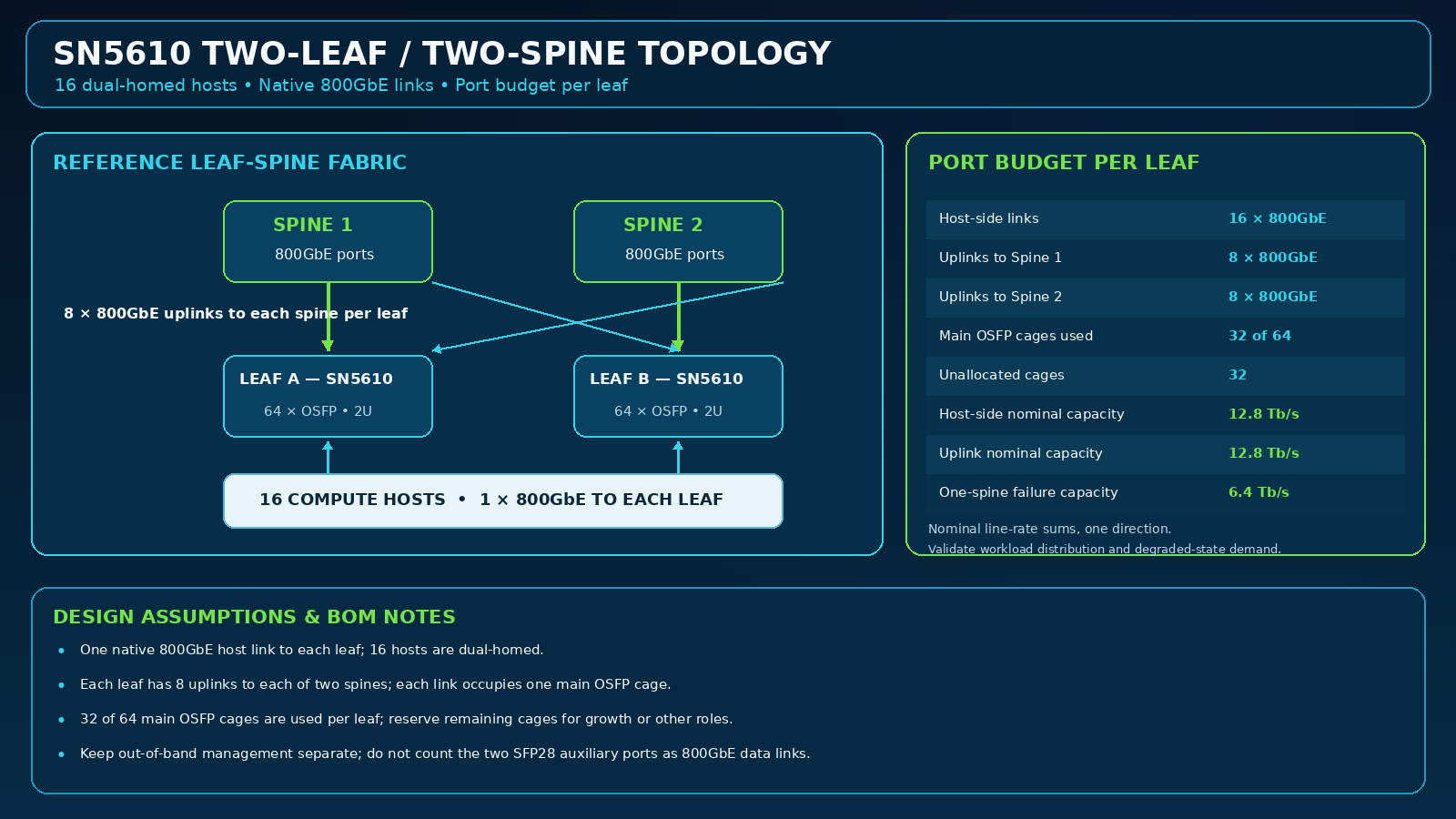
The diagram maps the host connections and leaf-to-spine links against the port budget.
Compare the alternative leaf choices
| Pair | What changes for the RoCE bill of materials |
|---|---|
| SN5610 vs SN5600D | Both are 64-cage OSFP options at 800GbE. AC SN5610 needs a PSU and PDU plan. DC SN5600D needs an MGX busbar, its rails and facility approval. Validate the peer media and management links on either chassis. |
| SN5610 vs SN5400 | SN5400 brings a native 400GbE QSFP56-DD plan. At the same uplink count it provides half the nominal bandwidth per 400GbE link in the 800GbE example. Recalculate available bandwidth and match the endpoint optical interfaces. |
The older AC SN5600 order is a separate lifecycle line. Use the current exact order number when validating support. NVIDIA Spectrum-4 ordering and lifecycle table
Qualify optics, switch ports and power together
For each server and spine link, write down the local switch port, peer OPN, Ethernet mode, lane rate, FEC and the exact assembly or optics at each end. Spectrum-4 800GbE data ports are documented with 100 Gb/s per-lane capability. A candidate advertised as 800G can describe a different lane arrangement or two 400G connections. Confirm the native port presentation across the switch, peer, media and host firmware. NVIDIA’s ConnectX-9 release notes list SN5610 among supported switches. Choose the media against the exact endpoint OPN and release and validate on one complete link before ordering multiples. NVIDIA SN5000 data interfaces · NVIDIA ConnectX-9 82.50.1002 validated cables and switches · SwitchInfra optics and cable checklist
Assign AC PSU connections to the validated feed and redundancy design, with facility sign-off on remaining capacity after a feed or PSU failure. Resolve cord type, PDU outlet capacity, rack depth and cooling before ordering. A proposed substitution to SN5600D 920-9N42F-00RI-KC0 changes the feed to a 48V DC MGX busbar and requires a different installation review. NVIDIA SN5000 ordering information
Accept the RoCE fabric under realistic load
- One link. Confirm native 800GbE, FEC health and transceiver telemetry with the exact cable and firmware. Save the endpoint and switch counters as a baseline.
- Two leaves and both spines. Test the agreed traffic class, ECN marking and, for the chosen lossless configuration, PFC on the intended priority. Verify priority and MTU consistency end to end.
- Workload and faults. Run representative collectives or storage access alongside competing traffic. Measure bandwidth, tail latency and congestion counters. Remove one spine in a controlled test and compare to the agreed degraded-state performance.
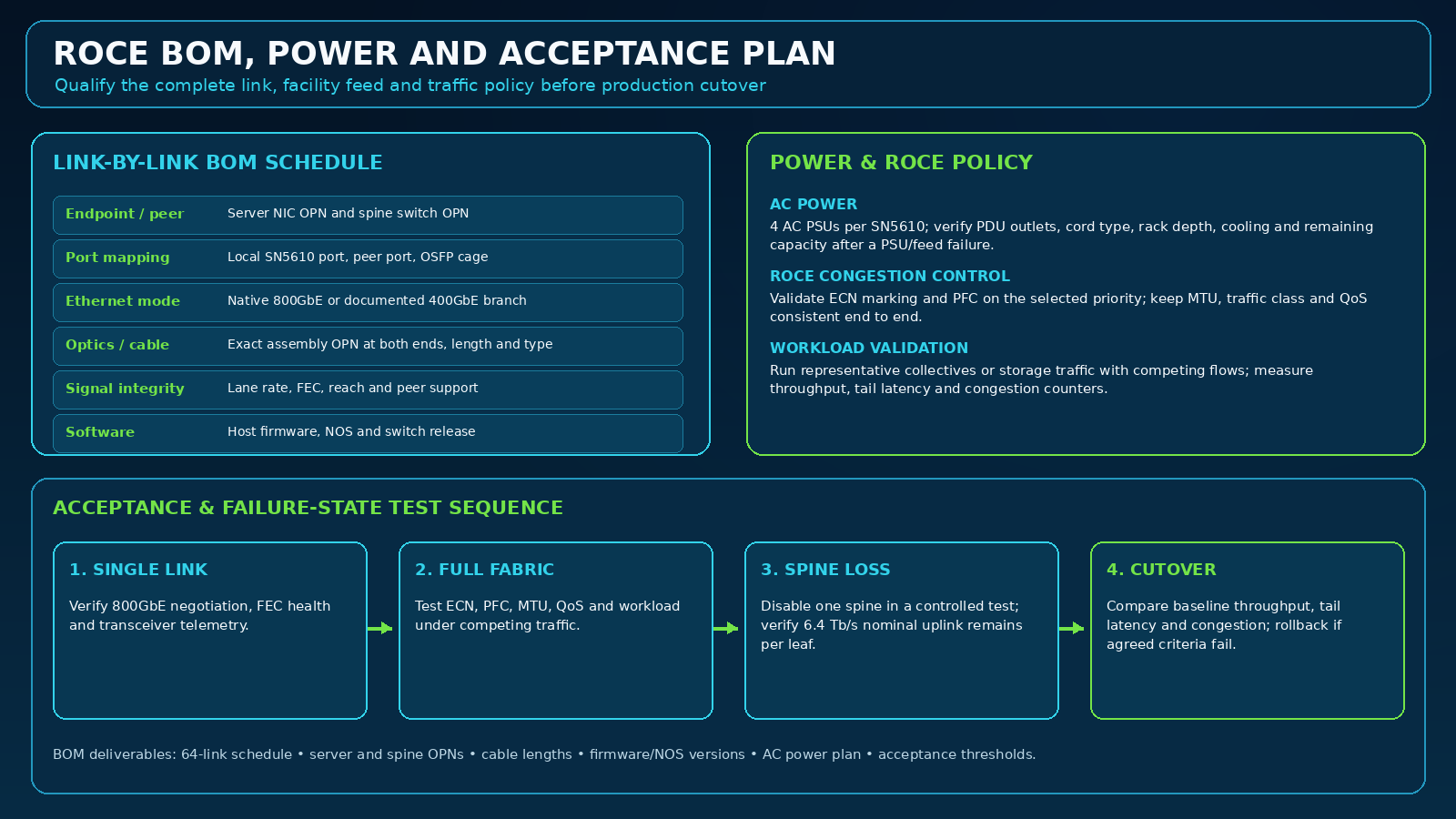
Check the optics and power path for each link, then verify the fabric under a representative workload.
Replacement decision and verification
Replacement decision. Evaluate SN5610 as an AC 800GbE leaf. A proposed SN5600D alternate needs a new DC rack approval as well as a supported Ethernet link plan. An SN5400 alternate represents a lower-rate media and capacity design. Recompute the surviving uplink capacity before accepting either change. NVIDIA Spectrum-4 order rows · NVIDIA Spectrum-4 data interfaces
Cutover check. Capture a repeatable workload, link counters and the existing RoCE traffic-class behavior before changing the leaf. Run the same test after the change and under the intended spine loss. Restore the prior path if agreed workload or reachability criteria fail.
Buying guide for the fabric bill of materials
Attach the 64-link schedule, cable lengths, server and spine part numbers, operating system and firmware versions, power architecture and acceptance thresholds to the request for a project quote. NVIDIA Cumulus Linux RoCE documentation · SwitchInfra 800G RoCE fabric architecture
Frequently asked questions
What is the difference between an 800GbE leaf port and a pair of 400GbE host links?
A native 800GbE link needs the compatible mode and media at both ends. A pair of 400GbE links uses its own port split and cable budget. Follow the endpoint documentation for the operating mode before applying the 16-host example. NVIDIA Spectrum-4 supported data interfaces · HGX AI Factory network hardware
What should I include in the one-spine failure test?
Measure surviving link and workload capacity, congestion counters and any loss of connectivity. The worked example allocates eight surviving 800GbE uplinks, or 6.4 Tb/s nominal per leaf. Record application measurements separately under the agreed load.
Acronyms and terms
- RDMA means Remote Direct Memory Access. RoCE means RDMA over Converged Ethernet.
- ECN means Explicit Congestion Notification. PFC means Priority Flow Control.
- FEC means forward error correction. MTU means maximum transmission unit.
- OSFP means Octal Small Form Factor Pluggable. PDU means power distribution unit. BOM means bill of materials.