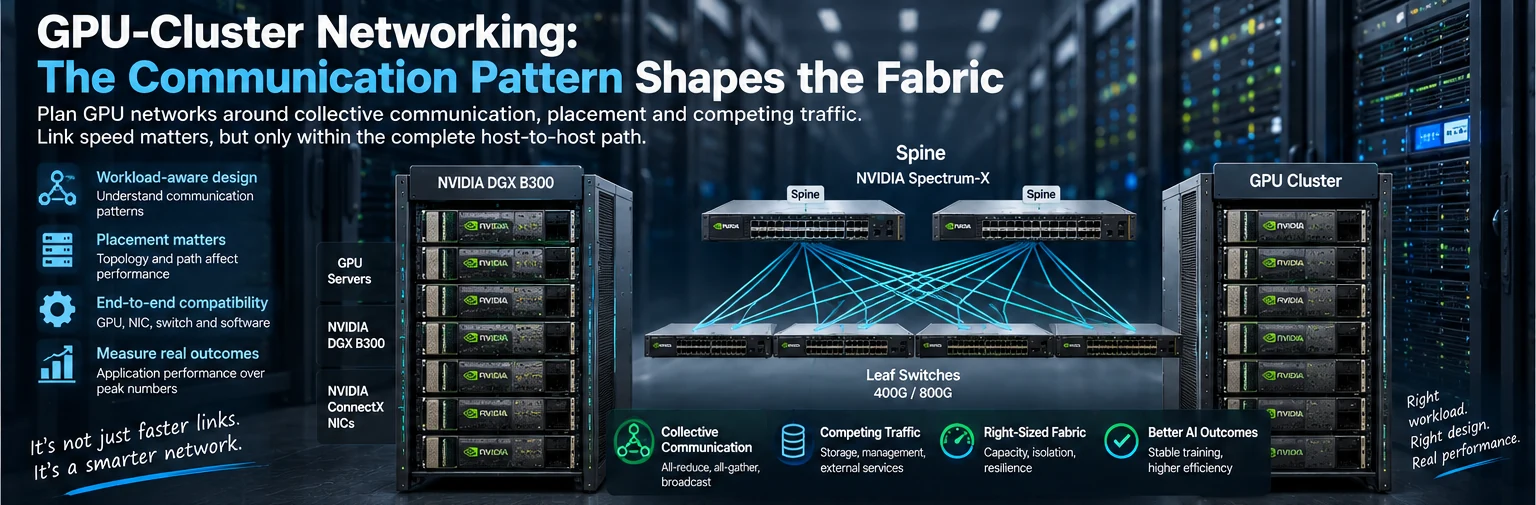
A GPU cluster is not simply a group of fast servers attached to a fast switch. Its network requirement depends on how work is divided, when nodes exchange data and which other services share the path.
That is why two clusters with the same GPU count can need different fabrics. The workload and placement model provide more useful starting points than the port-speed label alone.
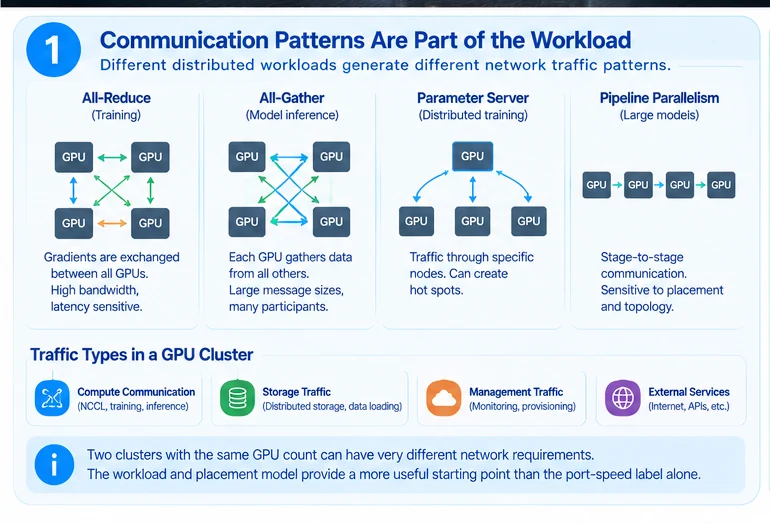
Communication is part of the workload
Distributed applications exchange data in patterns that differ from ordinary independent client requests. Collective operations can involve many participants, and their behavior depends on message size, process placement and topology. NVIDIA’s collective-test tooling makes these variables explicit in how communication is measured. R11
The design should document which jobs must span racks and how frequently they exchange data. It should also distinguish compute communication from storage access, external service traffic and management. Sharing infrastructure is a design choice that requires capacity and isolation assumptions, not a default consequence of having available ports.
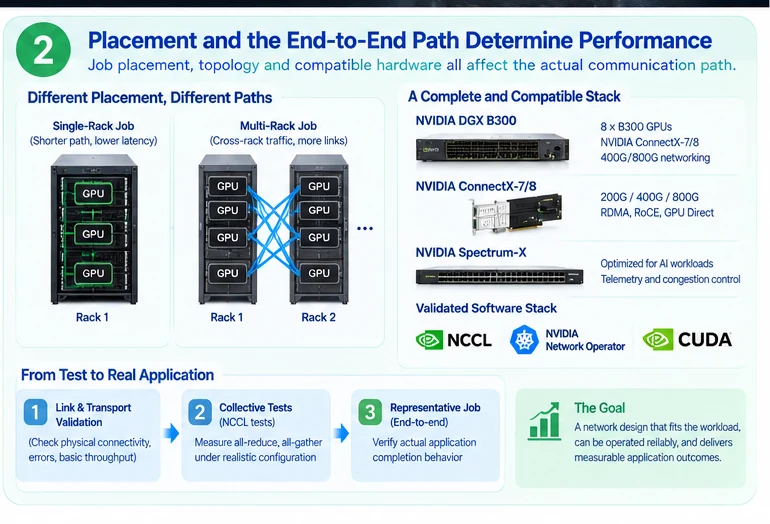
Placement can change the network path
An illustrative workload confined to one rack may cross a different set of links when its next run spans several racks. Even with the same number of processes, the bottleneck and failure exposure can change.
This makes job placement and network topology related operational decisions. A capacity model should identify the paths used under representative placement, not just count endpoints. It should explain what happens when the preferred placement is unavailable or a network component fails.
The server boundary matters
Adapters, host attachment and software must support the intended communication path. A GPU model name does not identify a complete server network configuration. NVIDIA’s DGX B300 documentation, for example, describes a full system with defined interfaces; it should not be reduced to assumptions about any server containing a similarly named GPU. R40
Use the applicable server and adapter support references and retain the actual software baseline. NVIDIA’s versioned platform matrices demonstrate that tested combinations are narrower than broad product-family descriptions. R10
Integration is useful only when the proposed combination uses it
AI-networking platforms can coordinate switches, adapters and software. Spectrum-X is described by NVIDIA as such a platform. That positioning does not certify an arbitrary mix of components or guarantee a vendor-advertised improvement for a different workload. R58
Identify the feature being relied upon, its prerequisites and the test that will show it is active. Include who owns the configuration across server and network teams.
| Planning layer | Question to answer |
|---|---|
| Workload | Which exchanges determine job progress? |
| Placement | Which racks and paths participate? |
| Host | Is the intended adapter and software path supported? |
| Fabric | Where can traffic concentrate or lose capacity? |
| Operations | How are configuration, telemetry and recovery coordinated? |
Measure the application outcome
Begin with physical and transport validation, then run repeatable collective tests and a representative job. Compare completion behavior under a controlled baseline, not only a peak bandwidth result.
A good GPU-network design explains why its capacity, topology and operating model fit the communication pattern. Faster ports may be part of that answer, but the workload—not the marketing generation—determines whether they solve the problem.
Engineering illustrations
These figures illustrate the design concepts discussed here. They are not measured results, certified configurations or a supplied-equipment list.