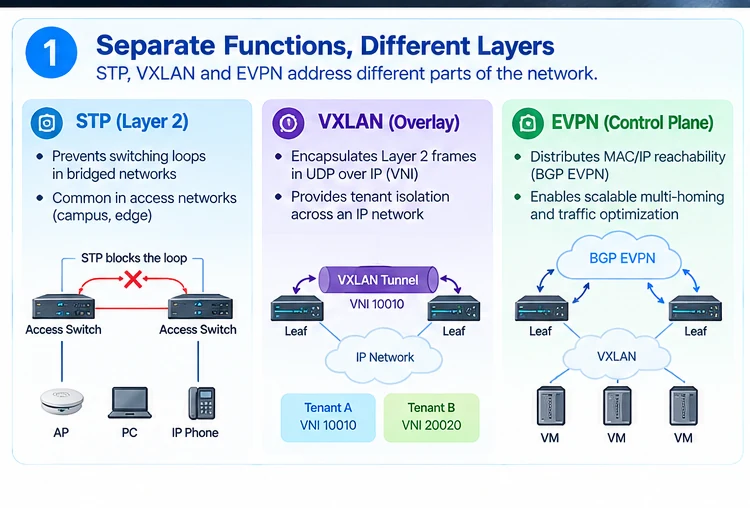
A comparison titled “EVPN-VXLAN versus STP” can imply that the technologies solve the same problem. They do not. The architectural choice becomes clearer when their functions are separated.
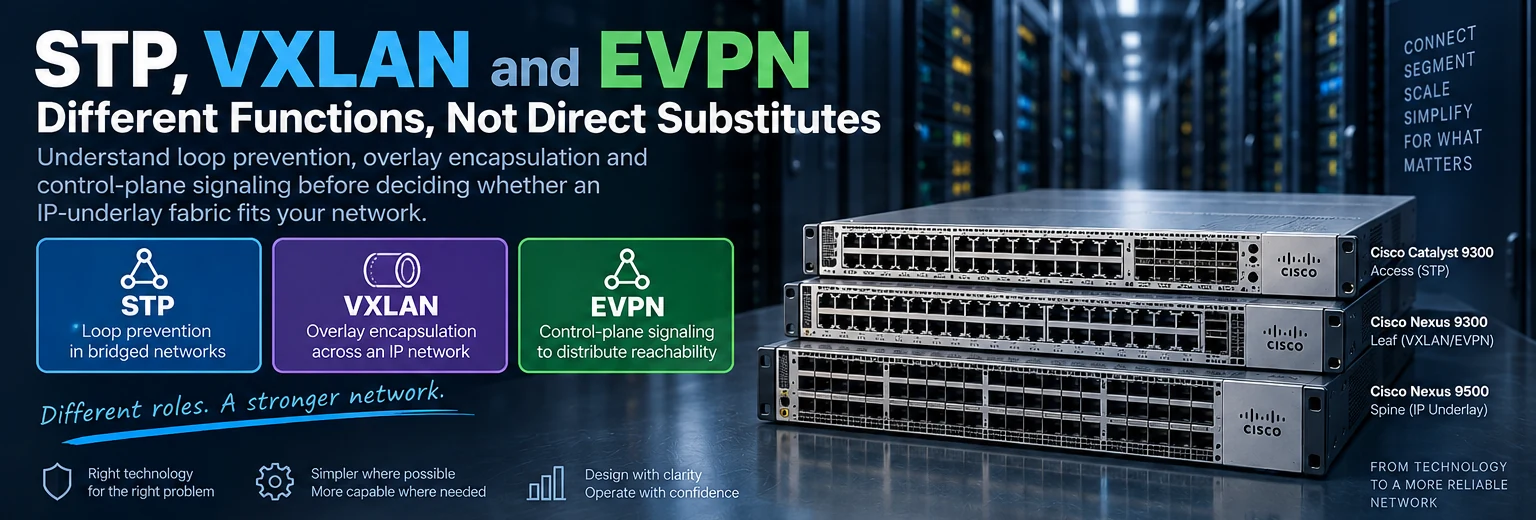
STP addresses loop prevention in bridged networks. VXLAN provides an encapsulation mechanism for carrying an overlay across an IP network. EVPN supplies a control-plane approach that can distribute reachability for such overlays. The VXLAN and EVPN specifications describe these different roles. R30R31
The underlay and overlay have separate responsibilities
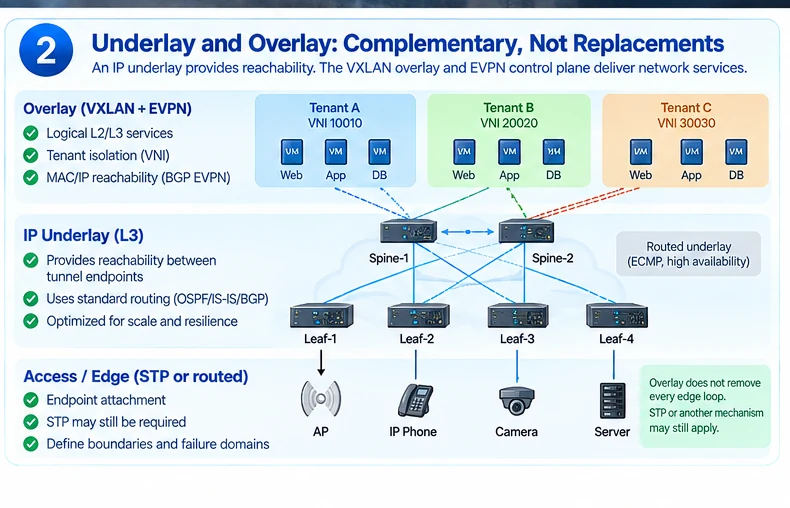
An IP underlay provides reachability between tunnel endpoints. The overlay provides the logical service presented to attached endpoints. Keeping those responsibilities distinct can support architectures that use routed paths while maintaining selected overlay services.
That does not mean every network needs an overlay. If a requirement can be met with a simpler routed or bounded Layer 2 design, adding EVPN-VXLAN introduces configuration and operational work that must be justified.
EVPN does not make every edge loop disappear
An overlay control plane does not automatically eliminate every bridging risk at access boundaries. The design still needs explicit treatment of endpoint attachment, multihoming where used and any remaining Layer 2 domains.
STP or another appropriate loop-control mechanism may remain relevant at those boundaries. The objective is to define where each mechanism applies, not to remove a familiar protocol merely because a new architecture has been introduced. Campus design guidance should be interpreted in the context of the chosen access and aggregation model. R45
Evaluate the service that requires the fabric
An illustrative requirement might need tenant separation and controlled Layer 2 extension across several racks. Another might only need routed connectivity among a small number of subnets. Those are different problems and can justify different levels of control-plane complexity.
List the required service behavior, scale and failure conditions. Then assess whether the candidate platform and release implement the necessary functions. A feature-name match is not enough to establish supported scale or interoperability.
| Function | Design responsibility |
|---|---|
| Bridging loop control | Keep the relevant Layer 2 domain loop-free |
| IP underlay | Provide stable reachability and the intended paths |
| VXLAN encapsulation | Map the selected overlay traffic to tunnel endpoints |
| EVPN control plane | Distribute the required overlay reachability and policy |
| Operations | Observe, troubleshoot and recover each layer separately |
Troubleshooting becomes layered
A failed service can originate in endpoint attachment, underlay reachability, encapsulation, route distribution or policy. The operating team needs a method to distinguish these layers and correlate their state.
Validate the underlay before the overlay, then test the required endpoint behavior and controlled faults. Retain the relevant configuration and state for each layer. Do not infer application resilience from a healthy routing session alone.
EVPN-VXLAN is an architectural tool, not a universal replacement label for STP. The useful decision is whether its service model and operational requirements fit the network—and whether the team can maintain the boundaries it introduces.
Engineering illustrations
These figures illustrate the design concepts discussed here. They are not measured results, certified configurations or a supplied-equipment list.