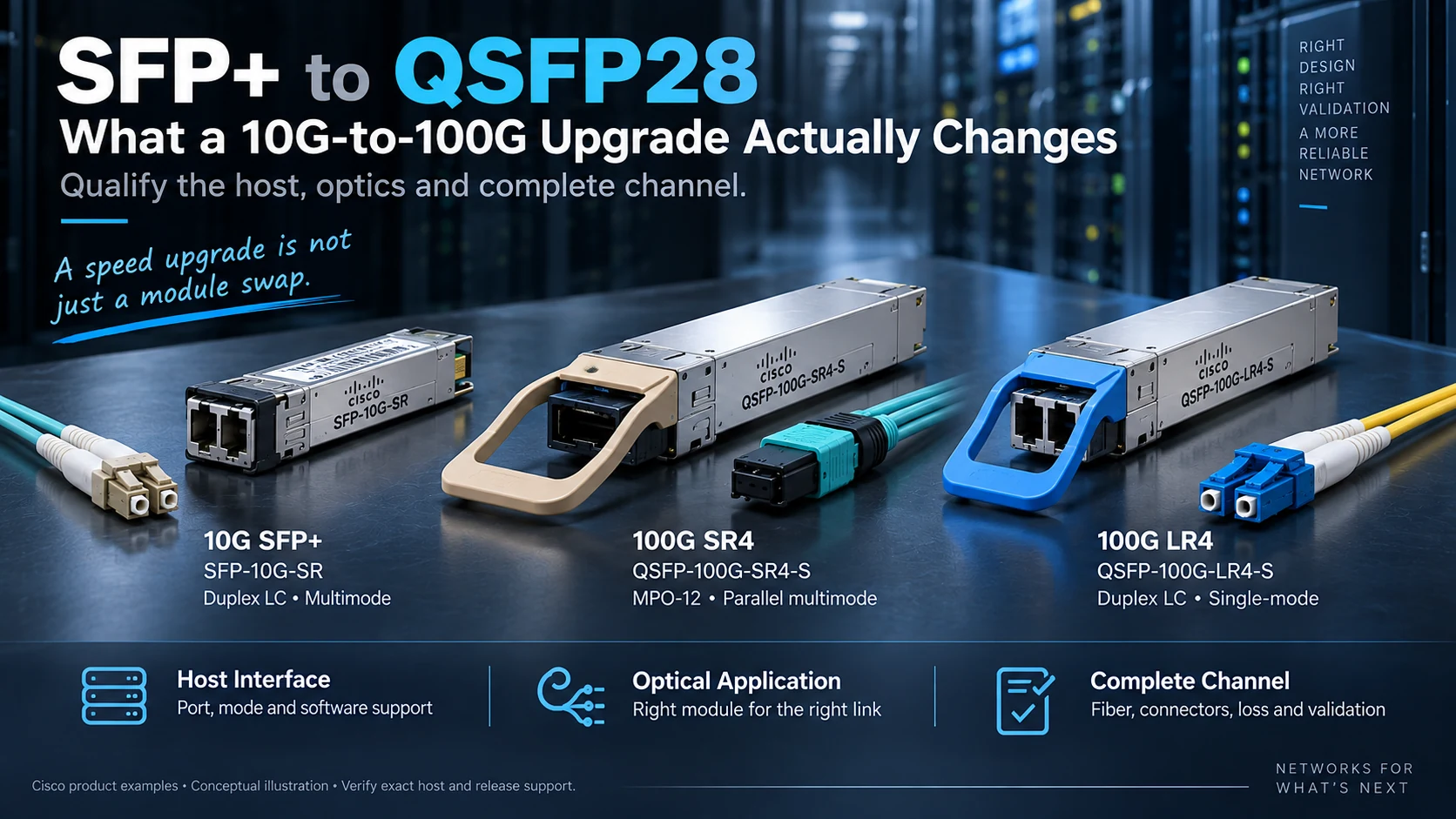
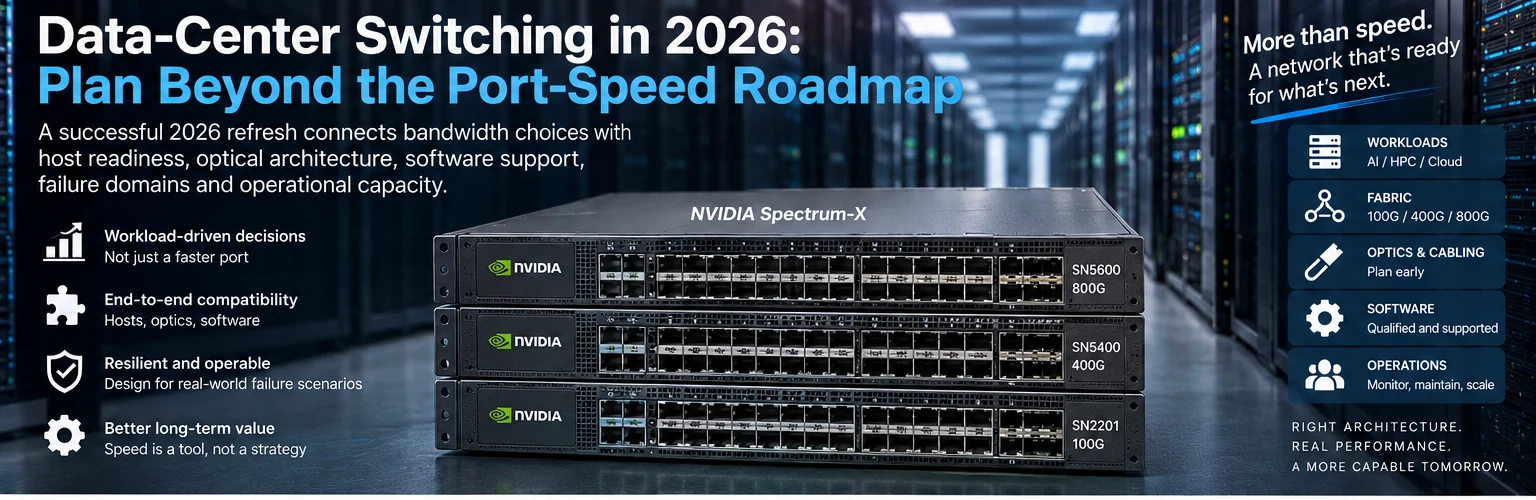
A port-speed roadmap is useful, but it is not a data-center strategy. The decision to retain 100G, introduce 400G or evaluate 800G should follow a workload and infrastructure assessment—not a calendar year in a product title.
For a 2026 refresh, the important development is the range of architectural choices available. The engineering task is to identify which of those choices changes the economics or behavior of a particular deployment. This article is a planning framework as of September 17, 2026, not a market-share forecast.
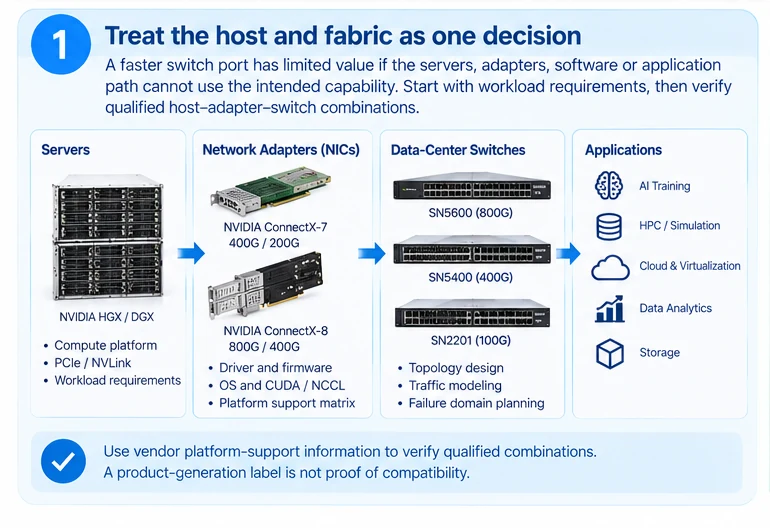
Treat the host and fabric as one decision
A faster switch port has limited value when the server installation, adapter, software or application path cannot use the intended capability. NVIDIA’s versioned platform-support information shows that validated combinations are more specific than a product-generation label. R10
Start with workload placement and endpoint requirements. Then model the traffic that crosses racks and failure boundaries. A refresh can be justified by growth, resilience or operational needs even when the nominal endpoint rate stays unchanged.
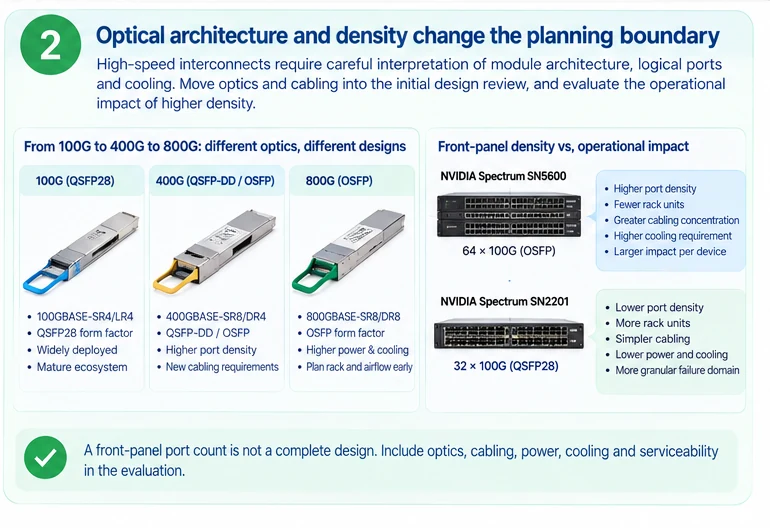
Optical architecture is becoming a planning boundary
High-speed interconnect choices require careful interpretation of logical ports, module capacity and cooling. NVIDIA’s documented twin-port implementations demonstrate that aggregate module rates cannot be used as a universal cable-counting rule. Its XDR hardware documentation also distinguishes system architectures that must be evaluated on their own terms. R01R43
The practical consequence is to move optics and cabling into the initial design review. They should not be selected after the switches have already determined the rack layout and budget.
Platform integration changes the qualification task
AI-oriented offerings can combine switches, adapters and software as a platform. NVIDIA describes Spectrum-X in those terms. That does not mean any assortment of products from the same vendor constitutes a validated configuration. R58
Ask which integration benefits the proposed combination actually provides, what release conditions apply and how the result will be measured. Do not convert a vendor-level performance claim into a guaranteed outcome for a different workload or topology.
Density has an operational cost
More ports per rack unit can reduce enclosure count while increasing the impact of a single replacement, concentrating cabling and complicating service access. These are design trade-offs to evaluate rather than reasons to reject density.
An illustrative comparison should include usable ports after uplinks and reserves, remaining capacity after a fault, total connection count and maintenance effort. A front-panel density ranking omits most of that information.
Build a roadmap with decision gates
| Gate | Evidence required before advancing |
|---|---|
| Capacity | A measured or explicitly modeled constraint |
| Compatibility | Qualified host, fabric and interconnect combination |
| Facility | Rack, power, thermal and service-space readiness |
| Operations | Supported software, monitoring and recovery capability |
| Value | Improvement tied to a service objective and complete cost |
A useful roadmap might retain an existing fabric for suitable workloads while qualifying a separate higher-speed domain for new demand. It should state the conditions that trigger expansion and the evidence that would change the plan.
The strongest 2026 decision is not automatically the fastest port. It is a configuration that the organization can install, operate and justify against its actual requirements.
Engineering illustrations
These figures illustrate the design concepts discussed here. They are not measured results, certified configurations or a supplied-equipment list.