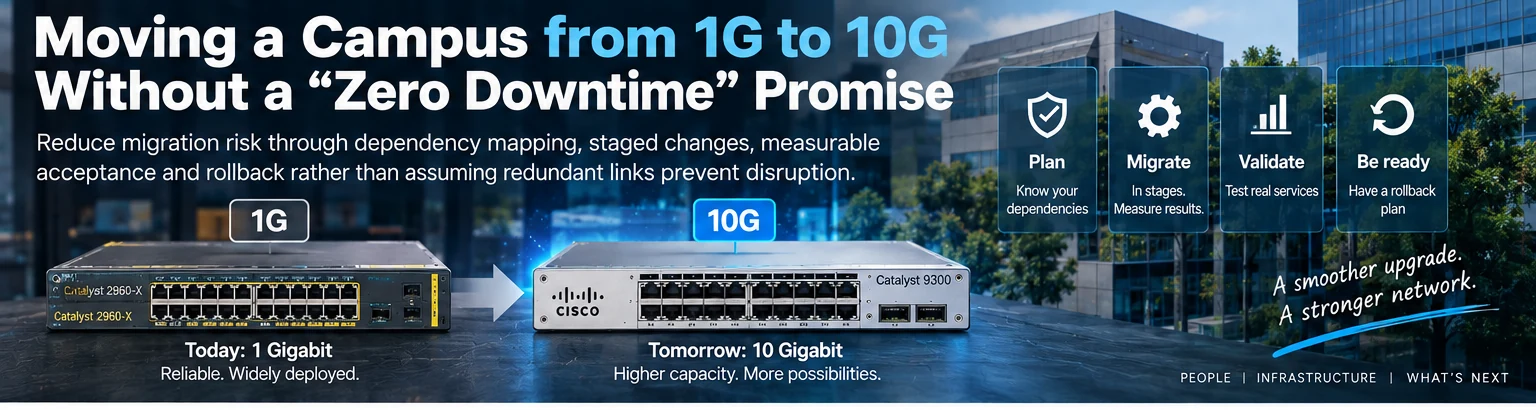
“Upgrade without downtime” is an attractive headline, but it is not a migration method. Replacing a link, switch or control-plane component can interrupt services even when the target architecture includes redundancy.
The practical objective is to reduce and control disruption. That requires a staged plan with explicit service dependencies, acceptance conditions and rollback decisions.
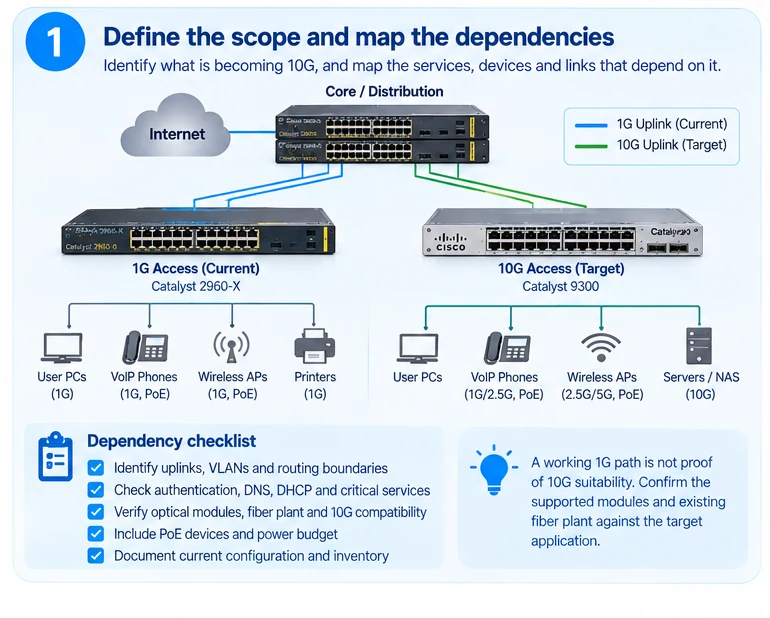
Define what is actually becoming 10G
An access-uplink upgrade is different from changing every endpoint-facing port. Document whether the constraint is between access and aggregation, at server attachment or somewhere outside the campus switching path.
Map the relevant hosts, uplinks, VLANs, routing boundaries, authentication dependencies and critical services. Cisco’s campus design guidance provides architectural context, but the migration sequence must reflect the installed environment. R45
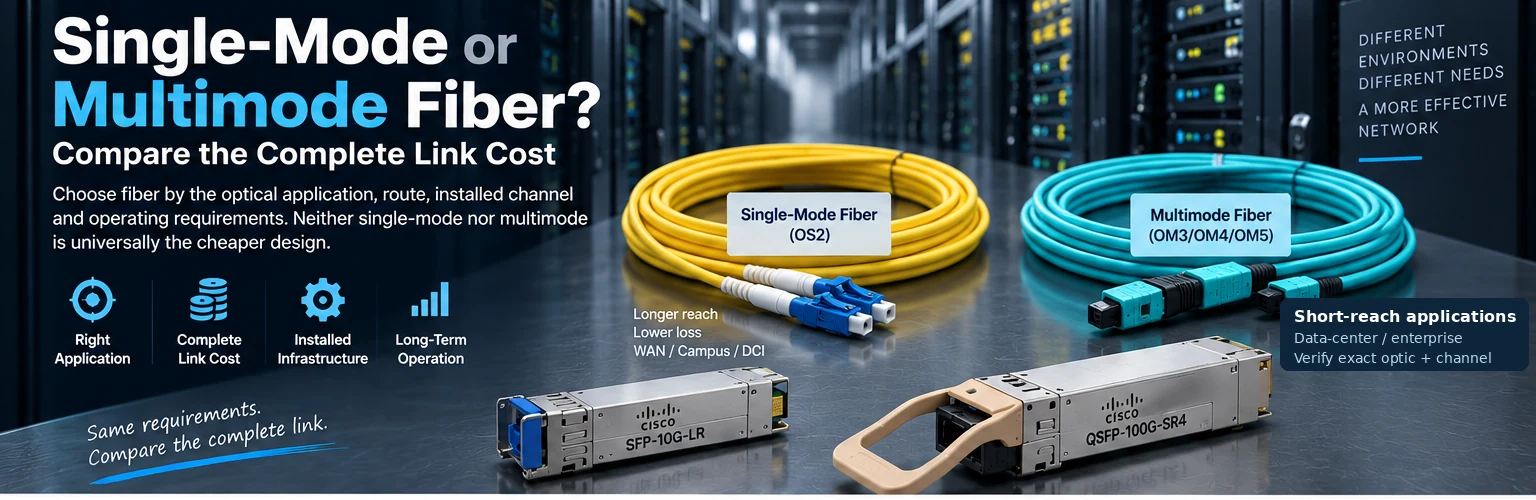
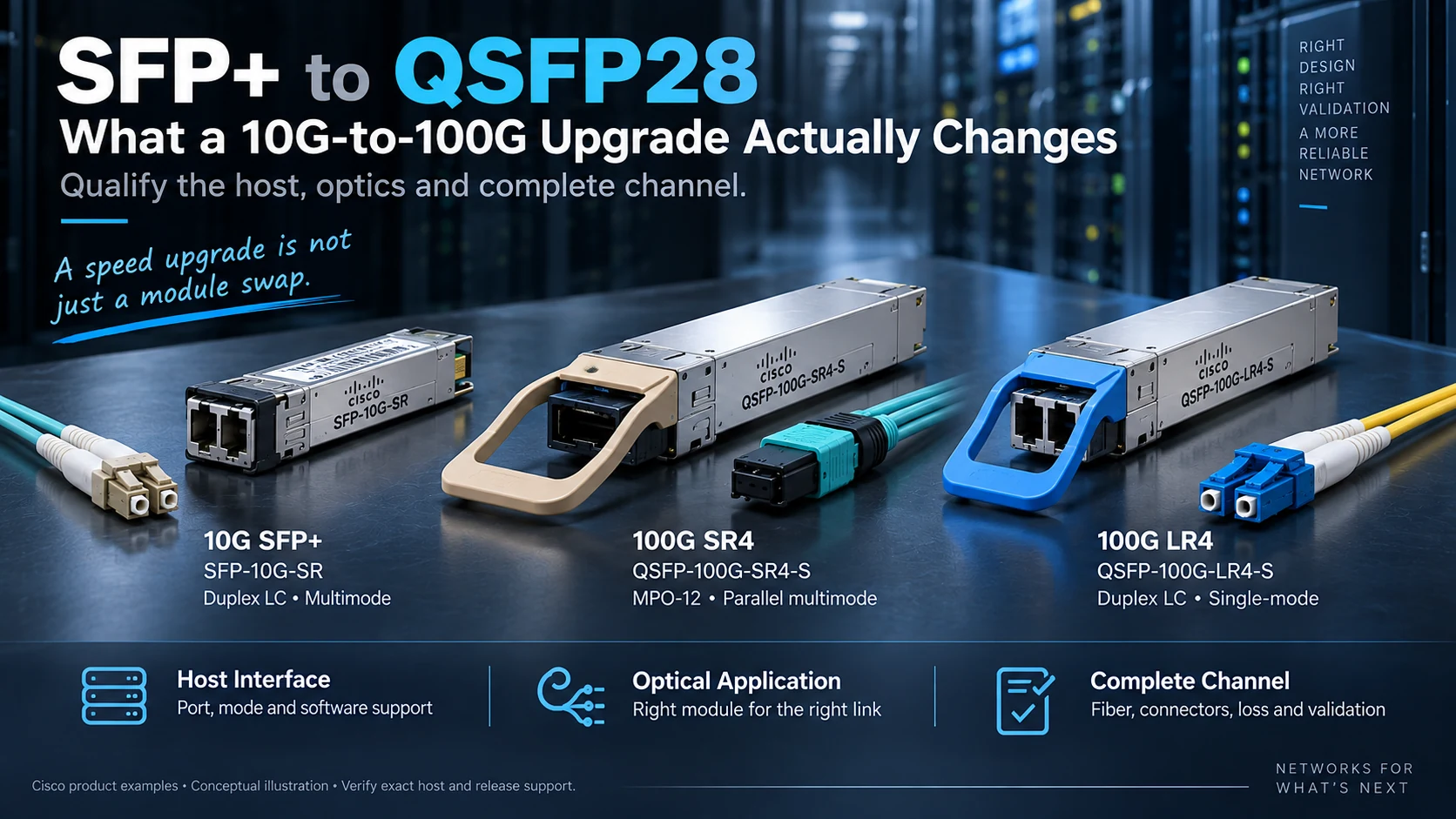
For optical uplinks, confirm the supported host module and transceiver combination and assess the existing channel against the target application. A working 1G fiber path is not by itself proof of 10G suitability. R13R18
Prepare the replacement before the window
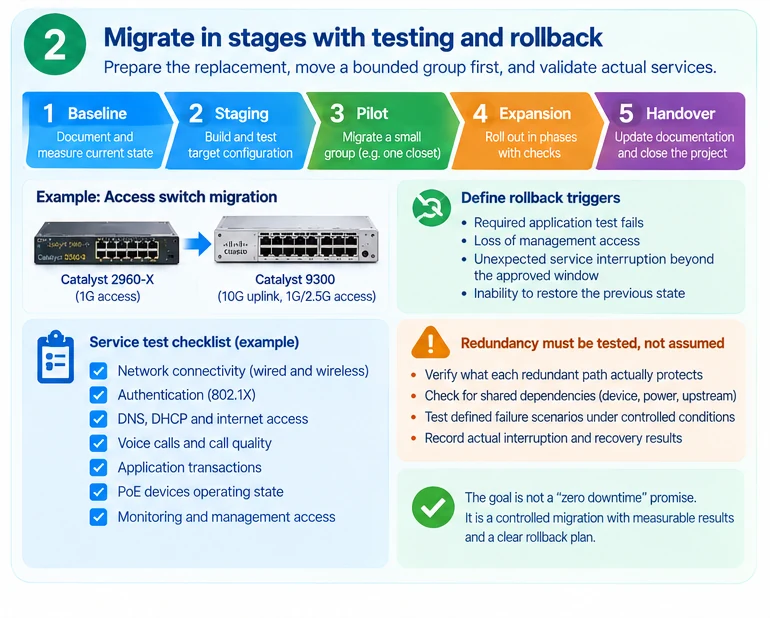
Build and review the target configuration in a controlled environment where possible. Establish management access, save the current configuration and retain the components needed to restore the old path.
Use an endpoint or service test list agreed with the business owner. It should include the services that can fail while basic connectivity still appears healthy: authentication, name resolution, voice, remote access or application transactions, as relevant to the site.
If access switches provide PoE, include device operating state and power allocation. A successful uplink change does not prove that every powered endpoint returned to its intended mode. R32
Move a bounded group first
An illustrative migration might begin with one noncritical closet or service group. Measure the transition, compare results with the baseline and resolve unexpected behavior before expanding.
Define a rollback trigger in observable terms. Examples include failure of a required application test or inability to restore management access within the approved window. These thresholds must be set for the project; they are not universal recommendations.
| Phase | Required outcome |
|---|---|
| Baseline | Known configuration and service behavior |
| Staging | Reviewed target setup and tested recovery access |
| Pilot | A bounded change with measured impact |
| Expansion | Repeated checks after each migration group |
| Handover | Updated inventory, diagrams and recovery procedure |
Redundancy must be tested, not assumed
Determine what each redundant path protects. Two uplinks may still share a device, power source or upstream dependency. A control-plane event can affect both even when the physical cables remain intact.
Test the defined failure scenarios only under approved conditions. Record actual application interruption and recovery actions rather than reporting only routing or interface convergence.
A credible migration plan states where disruption remains possible and how it will be managed. That is more useful to an operations team than an absolute promise—and more likely to produce a controlled transition to the intended 10G service.
Engineering illustrations
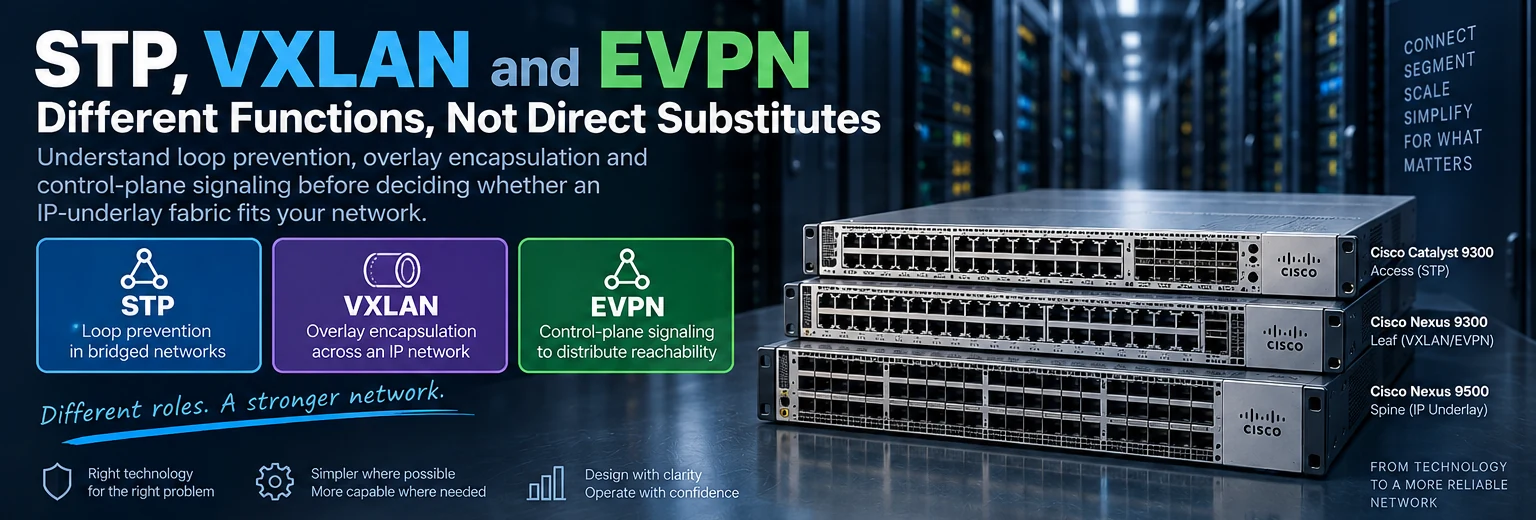
These figures illustrate the design concepts discussed here. They are not measured results, certified configurations or a supplied-equipment list.