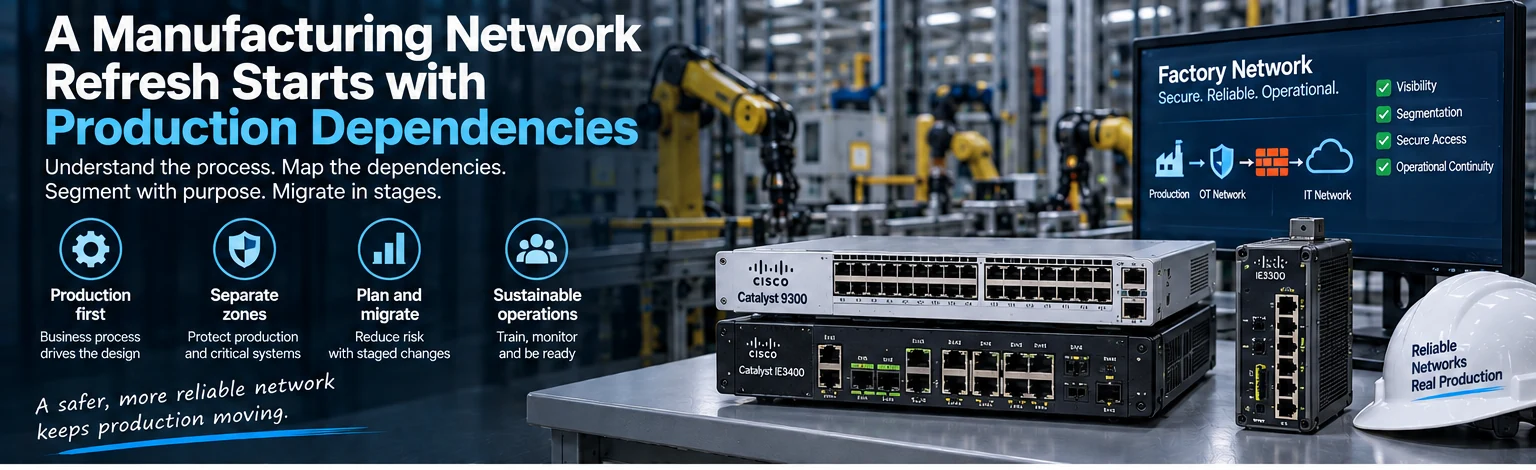
A factory network can carry office applications, engineering access, video, production data and equipment communication. Treating all of those flows as one ordinary LAN makes a refresh difficult to plan and potentially disruptive.
The following is an illustrative planning scenario, not a report about an actual customer. Its purpose is to show the decisions a manufacturing network team should resolve before replacing equipment.
Begin with the process, not the switch inventory
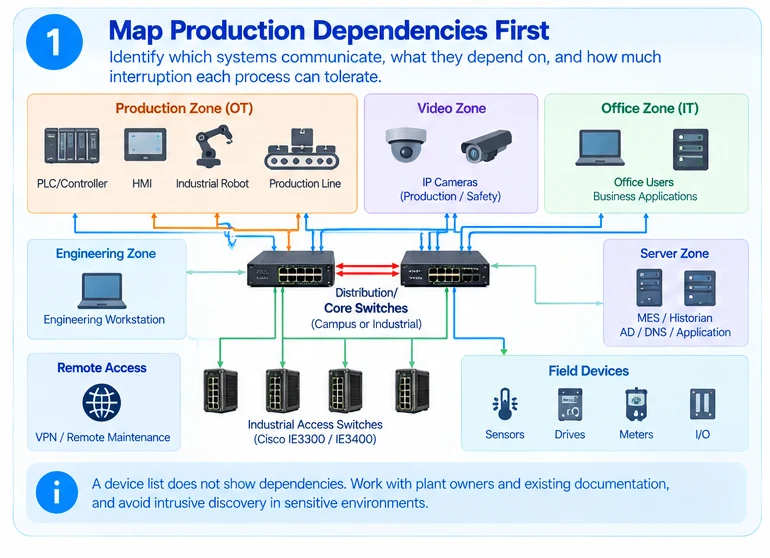
Assume a site has office users, production cells, a video system and remote maintenance access. The first task is to identify which services depend on which paths and what interruption each process can tolerate.
Map endpoints and communication relationships with the appropriate plant owners. Passive observation and existing documentation may be preferable to intrusive discovery in sensitive environments. NIST’s OT security guidance emphasizes operational constraints that differ from ordinary enterprise IT assumptions. R34
A device list is useful, but it does not explain what happens when a link is changed during a production cycle.
Separate zones according to required communication
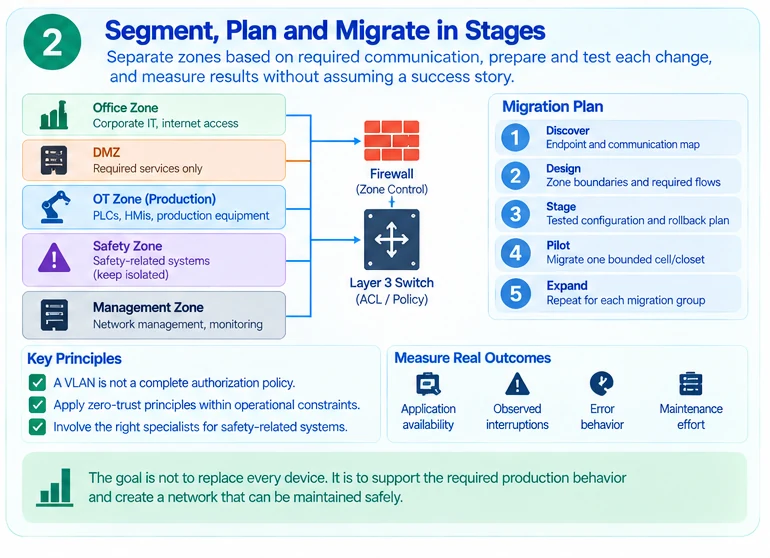
Define boundaries for office systems, production cells, management and remote access. Document the flows that must cross them and the controls used at those boundaries.
A VLAN is not, on its own, a complete authorization policy. NIST’s zero-trust guidance frames access around explicit resource and policy decisions rather than implicit trust from network location alone. Apply that principle within the operational constraints of the site; do not describe a segmentation drawing as a complete zero-trust implementation. R35
Keep safety-related systems outside generic network-design assumptions. Any change affecting them requires the responsible specialists and applicable procedures.
Choose a migration unit the plant can control
Instead of replacing the entire site at once, define a bounded cell, closet or service group. Prepare the target configuration and recovery path before the approved maintenance window.
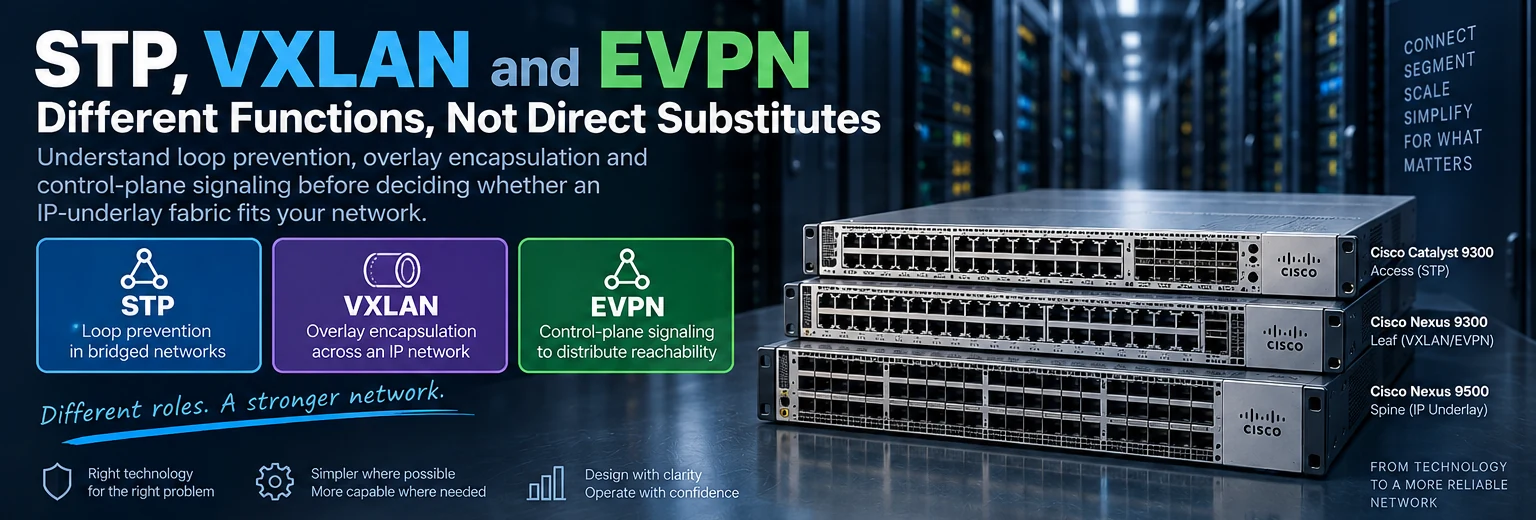
Campus architecture guidance can inform aggregation and access design, but it does not replace the factory’s process-specific requirements. R45
| Stage | Planning output |
|---|---|
| Discover | Approved endpoint and communication map |
| Design | Zone boundaries, required flows and recovery access |
| Stage | Tested target configuration and rollback materials |
| Pilot | One bounded change with service observations |
| Expand | Repeated acceptance for each migration group |
Measure outcomes without inventing a success story
Choose baseline measures that the site can actually collect: application availability during the window, observed interruptions, required flows, error behavior and maintenance effort. Record the conditions and measurement method.
Do not announce a reliability increase or cost reduction before comparable evidence exists. A reduction in switch count, for example, is not automatically a reduction in total operating risk. Likewise, fewer support tickets can reflect a change in reporting rather than a healthier network.
Hand over an operating model
The final deliverable should include the communication map, approved configuration, monitoring responsibilities, access process and recovery procedure. Train the people who will handle the next maintenance event, not only the engineers who designed the refresh.
A manufacturing modernization succeeds when the new network supports the required production behavior and can be maintained safely. That is a more meaningful objective than replacing every old device or attaching an unsupported savings percentage to the project.
Engineering illustrations
These figures illustrate the design concepts discussed here. They are not measured results, certified configurations or a supplied-equipment list.