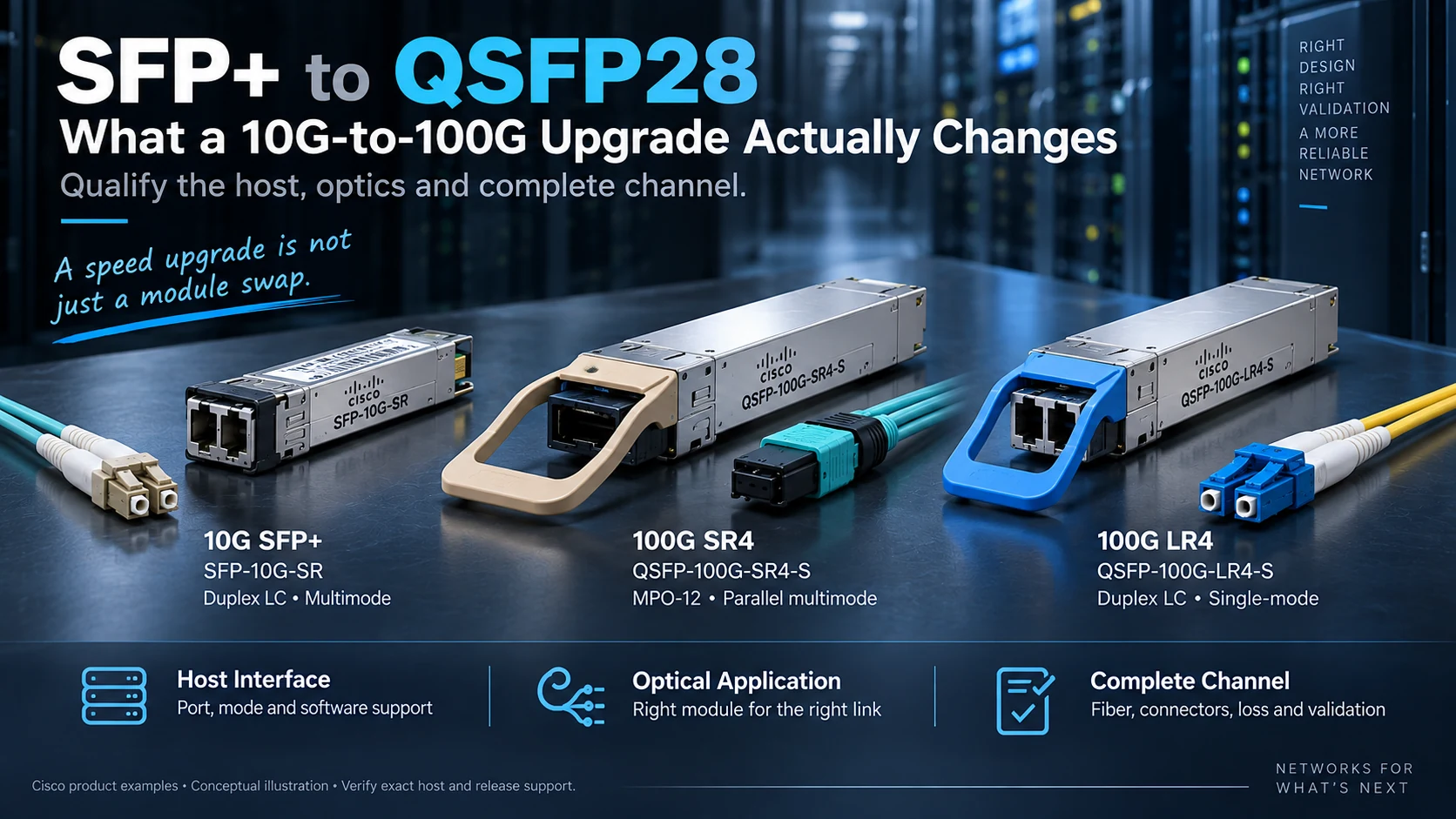
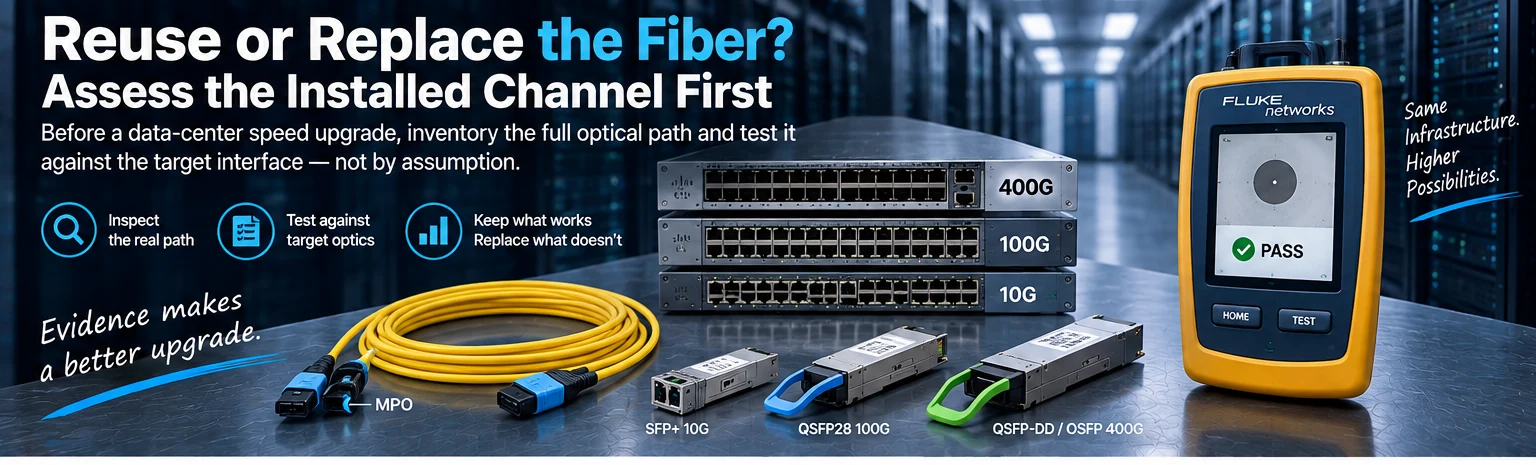
A network-speed upgrade often triggers one of two assumptions: all existing fiber must be replaced, or any working fiber can be reused. Both skip the engineering question that matters—whether the installed channel meets the requirements of the target optical application.
Assessing that channel can preserve useful infrastructure while exposing the parts that genuinely need to change.
Inventory the path, not just the backbone cable
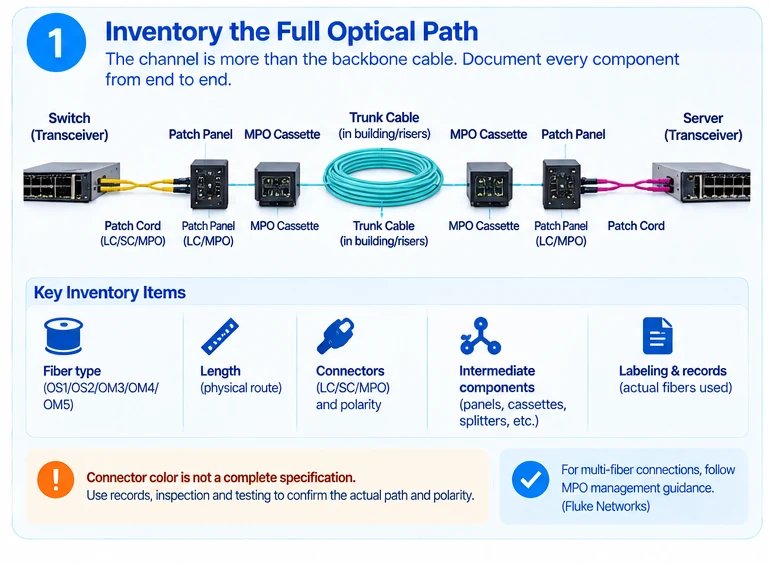
Record the fiber type, routed length, connector arrangement and all intermediate components. Include patch cords, panels, cassettes and any conversion between connector types. The permanent cable is only part of the channel.
For multi-fiber connections, establish polarity and the actual fibers used by the application. Fluke Networks’ MPO guidance explains why multi-fiber connector arrangements require deliberate management rather than visual matching alone. R42
Use labeling, records and appropriate inspection to establish identity. Connector color by itself should not be treated as a complete specification.
Match the channel to the new optical application
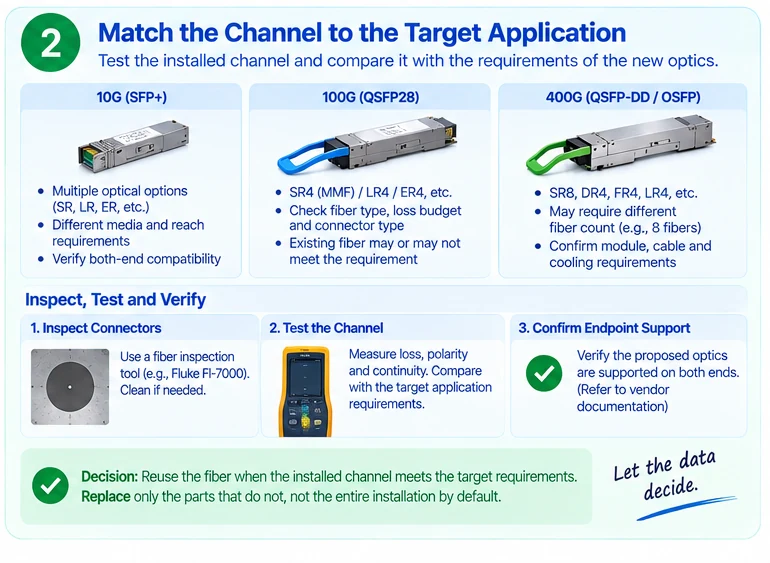
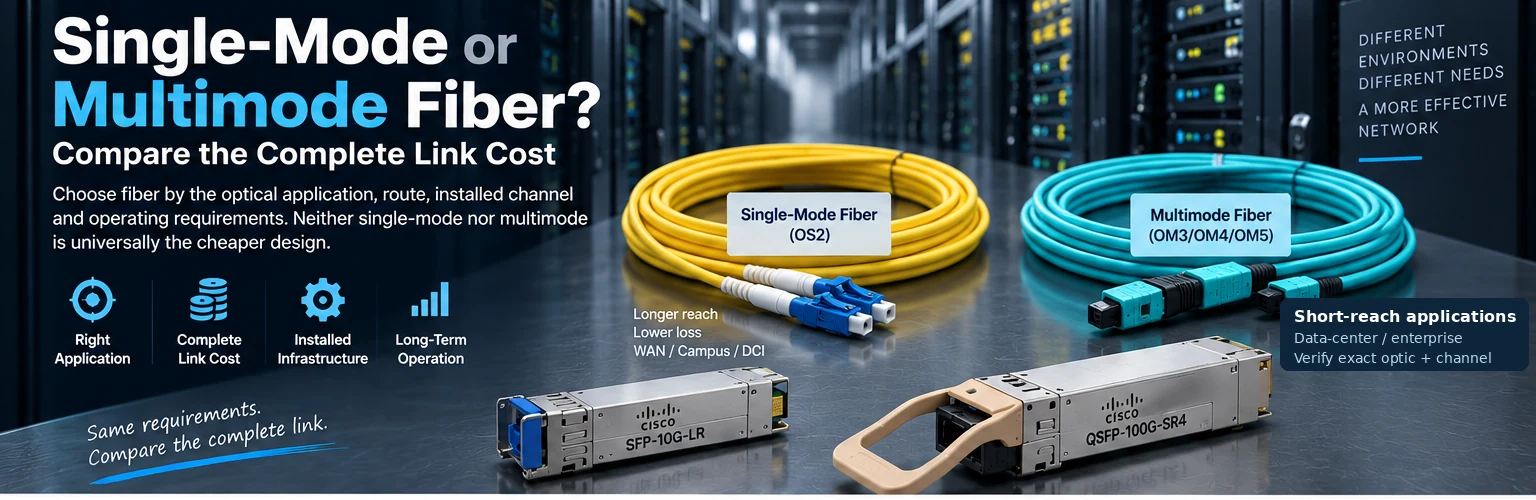
The target rate does not determine a single fiber solution. Cisco’s 10G and 100G module documentation contains different optical applications with different media and reach conditions. The selected interface at both ends defines what the channel must support. R18R25
A change in optics may alter the active-fiber count, connector requirements or loss allowance. An existing channel can be physically intact yet unsuitable for the proposed application.
Separate cleanliness from channel performance
Inspect connectors using appropriate equipment and procedures before mating them. Fluke’s inspection documentation provides a reference for connector-end-face assessment. Cleanliness is essential, but a clean connector does not prove the entire channel meets its loss and application requirements. R17
Use the applicable test method for the channel and retain the results. Investigate unexpected loss rather than immediately replacing the whole route or compensating with a different optic without review.
| Evidence | Decision it supports |
|---|---|
| Route and component inventory | What is actually being reused? |
| Connector inspection | Are mating surfaces acceptable? |
| Polarity and continuity | Are the intended paths connected correctly? |
| Channel measurements | Does the installed path meet the selected application? |
| Endpoint qualification | Are the proposed optics supported at both ends? |
Replace the constraint, not the entire installation by default
An illustrative assessment may find that the backbone is suitable but the patching arrangement is not. Another may reveal that the required application exceeds the installed channel’s capability. These findings lead to different scopes of work.
Compare the cost, disruption and future maintainability of the qualified options. Keep the decision tied to a documented target interface rather than a vague promise that one cable type is universally future-proof.
Preserve the evidence for the next upgrade
Update labels, drawings and the channel record after any change. Include the final optics, connector path, test method and results. A future engineer should be able to determine what was qualified without reconstructing the route from scratch.
Fiber reuse is valuable when it is supported by evidence. Replacement is justified when it resolves a defined constraint. The installed channel—not the assumption—should decide which path is appropriate.
Engineering illustrations
These figures illustrate the design concepts discussed here. They are not measured results, certified configurations or a supplied-equipment list.