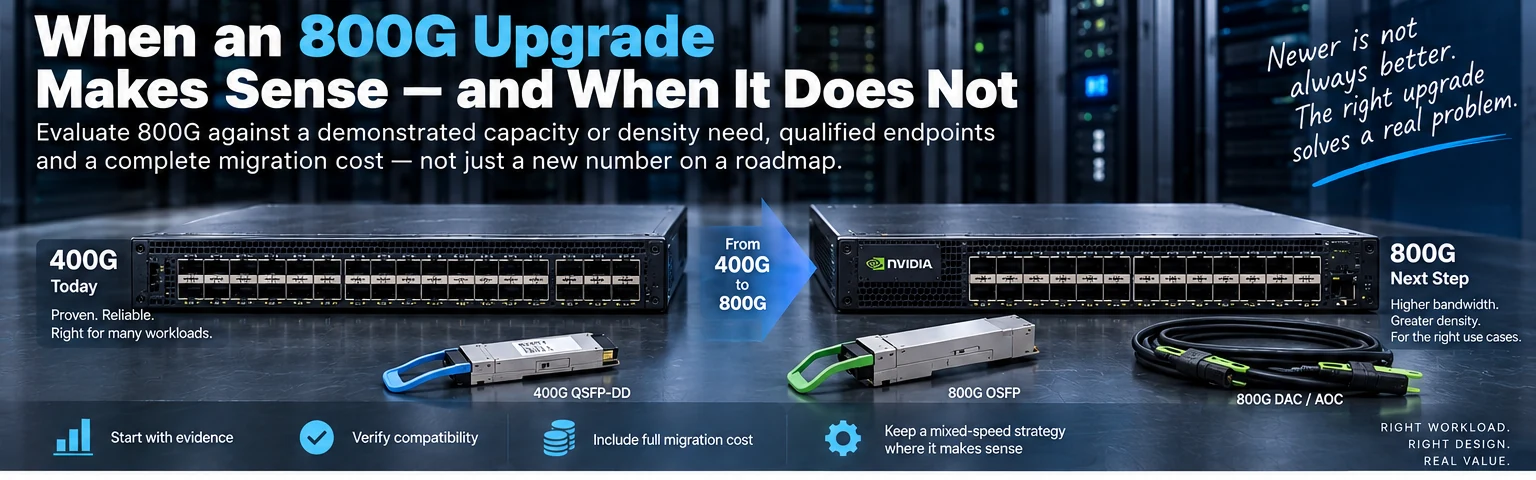
The availability of faster interfaces does not make the previous generation obsolete for every workload. An 800G upgrade is useful when it resolves a defined constraint within a supported system. Without that connection, it can simply move spending ahead of the requirement.
The decision should begin with evidence about the existing fabric and a specific explanation of what the proposed change will improve.
Identify the constraint before the replacement
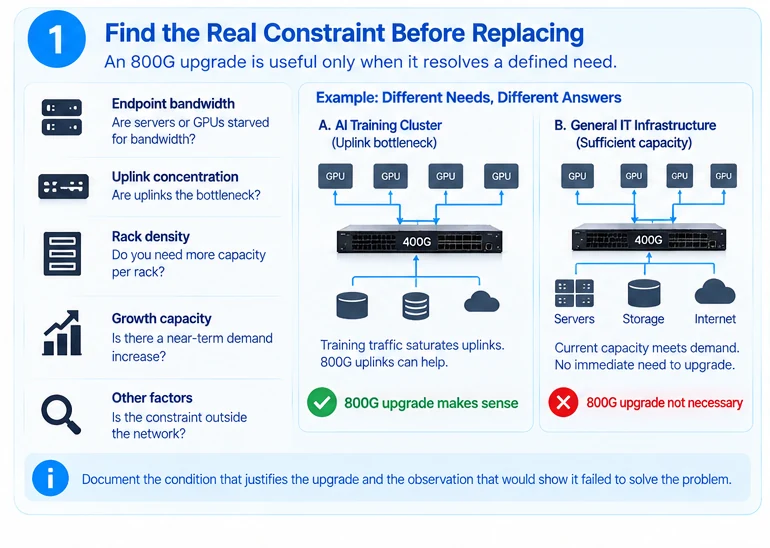
Is the problem endpoint bandwidth, uplink concentration, rack density, growth capacity or something outside the network? Measure the relevant path or create an explicit demand model when production data is not yet available.
An illustrative deployment may need more uplink capacity while its existing server-facing rate remains appropriate. Another may need a new high-speed domain for a different workload. Neither case implies that every interface should be upgraded at once.
State the condition under which the upgrade is justified and the observation that would show it failed to solve the problem.
Confirm what the 800G label represents
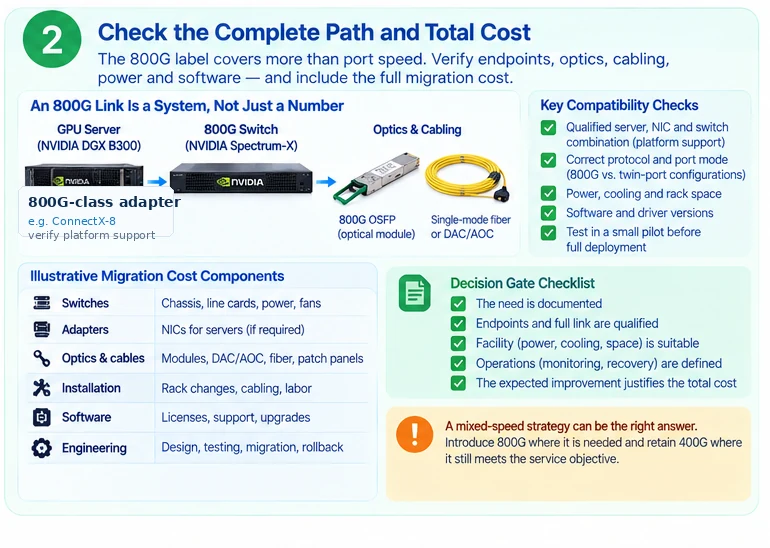
Logical port rate and combined module capacity are different quantities. NVIDIA’s interconnect documentation describes twin-port arrangements whose aggregate labels cannot be interpreted as one universal link type. Its XDR hardware documentation defines another platform-specific set of port and installation requirements. R01R43
The proposed protocol, endpoint mode, module, cable path and cooling form must agree. Reusing an existing assembly is an engineering decision, not an automatic benefit of matching the headline number.
Check endpoint readiness and integration
The server installation, adapter and software need to support the intended capability. Versioned platform support is narrower than a claim that a device family is “800G-ready.” R10
For integrated AI-networking platforms, identify the supported switch, adapter and software combination. NVIDIA positions Spectrum-X as a coordinated platform; that should not be interpreted as validation of any collection of NVIDIA components. R58
A small qualification domain can reveal compatibility and operational issues before they become rack-scale rework.
Price the complete transition
Include switches, adapters where required, optics, cabling, installation changes, software and engineering work. Also account for the need to maintain the current service during migration.
| Decision gate | Proceed only when |
|---|---|
| Need | The target constraint is documented |
| Compatibility | Both endpoints and the full link are qualified |
| Facility | Power, cooling and service space are suitable |
| Operations | Monitoring, software ownership and recovery are defined |
| Value | The expected improvement justifies the complete transition cost |
These are not a scoring system or a guarantee of benefit. They expose the conditions that must be satisfied before a pilot can support a procurement decision.
Retain a mixed-speed strategy where it is justified
Different parts of a network can serve different requirements. A staged plan may introduce a faster domain while retaining an existing one that still meets its service objective. Document the boundaries and avoid unsupported inter-generation assumptions.
The right question is not whether 800G is newer. It is whether a particular 800G configuration improves a measurable outcome at an acceptable total cost and operating burden. A qualified upgrade has a reason to exist beyond its position on a roadmap.
Engineering illustrations
These figures illustrate the design concepts discussed here. They are not measured results, certified configurations or a supplied-equipment list.