
Network engineering
Enterprise LAN Solutions: Build Around Services, Failure Domains and Operations
Plan an enterprise LAN by aligning access requirements, aggregation capacity, segmentation and recoverable operations.
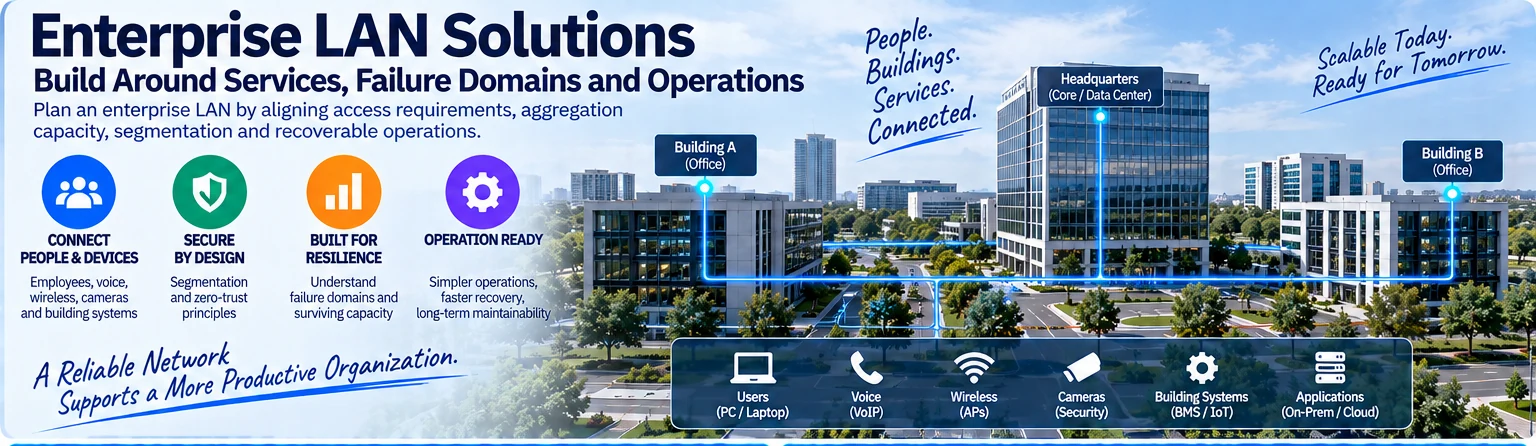
An enterprise LAN must connect users and devices to required services while remaining understandable during change and failure. Its architecture should reflect the organization’s buildings, endpoint mix and operating capability. More layers or more advanced features are not automatically better.
Establish the service map
List employee devices, voice, wireless access points, cameras, building systems and administrative services. Record which groups must communicate and which should remain separated. Identify the services that require continuity during a link, switch or power event.
Treat segmentation as a service-policy decision, not only a VLAN-numbering exercise. A network segment does not, by itself, establish trusted access to an application. NIST’s zero-trust guidance is useful context for separating network location from authorization. R35
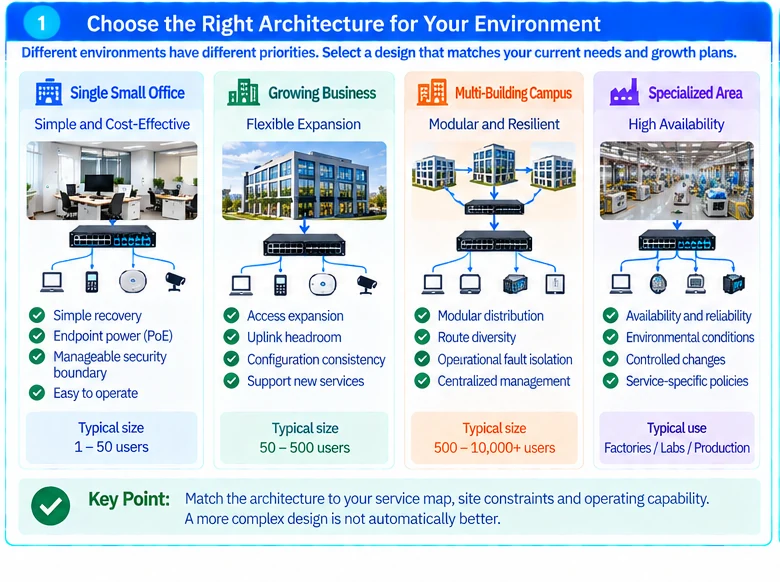
Select the appropriate architecture
| Environment | Design questions to prioritize |
|---|---|
| Single small office | Simple recovery, endpoint power and a manageable security boundary |
| Growing business | Access expansion, uplink headroom and configuration consistency |
| Multibuilding campus | Modular distribution, route diversity and operational fault isolation |
| Specialized production area | Availability, environmental conditions and controlled changes |
Use the small-office, business-office and large-campus solution pages for their respective implementation scopes. Campus architecture guidance provides useful design patterns, but the chosen pattern still needs a site-specific capacity and resilience model. R45
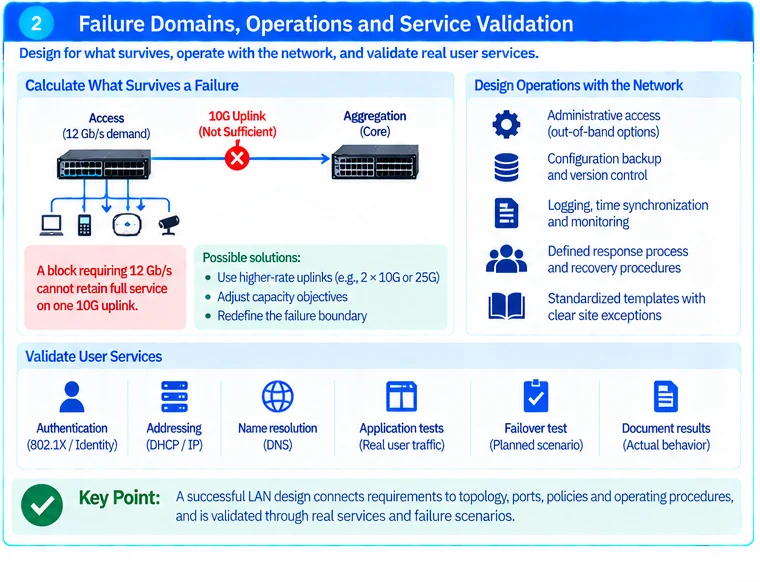
Calculate what survives a failure
Count endpoint demand, uplink capacity and power allocation independently. Then repeat the calculation under the failure condition the design is meant to tolerate. Redundant-looking drawings can conceal a common power source, shared cable route or insufficient surviving capacity.
An illustrative access block requiring 12 Gb/s during its defined busy period cannot retain that service level on one surviving 10G uplink. The correction might be a higher-rate path, a different capacity objective or a different failure boundary—not simply another redundancy label.
Design operations with the forwarding network
Define administrative access, configuration backup, logging, time synchronization and monitoring. Decide who responds to alerts and how a technician recovers a device when normal network access is unavailable.
Standardize repeatable access-block configurations while keeping site exceptions explicit. A template should reduce accidental variation, not hide differences in uplinks, power or endpoint roles.
Validate user services
Acceptance should include authentication, addressing, name resolution and representative application transactions in addition to link and routing checks. Test the chosen recovery scenario in an approved window and document its actual effect.
The design package should connect requirements to topology, ports, policies and operating procedures. For project scoping, provide endpoint groups, buildings, application dependencies, current equipment and the failures that must be tolerated. Those inputs produce a LAN that can be maintained, not merely installed.
Engineering illustrations
These figures illustrate the design concepts discussed here. They are not measured results, certified configurations or a supplied-equipment list.
Related reading
- Office Network Design for Growing Businesses: Capacity Without Unnecessary Complexity
- Large Campus Network Design: Modular Access Blocks and Clear Failure Domains
- Network Switch Selection Worksheet: Turn Requirements into a Comparable Shortlist