Qualify Networking ICs as an OEM Design Project
How to evaluate ConnectX and BlueField IC procurement without confusing a silicon family, an adapter card and a qualified production system.
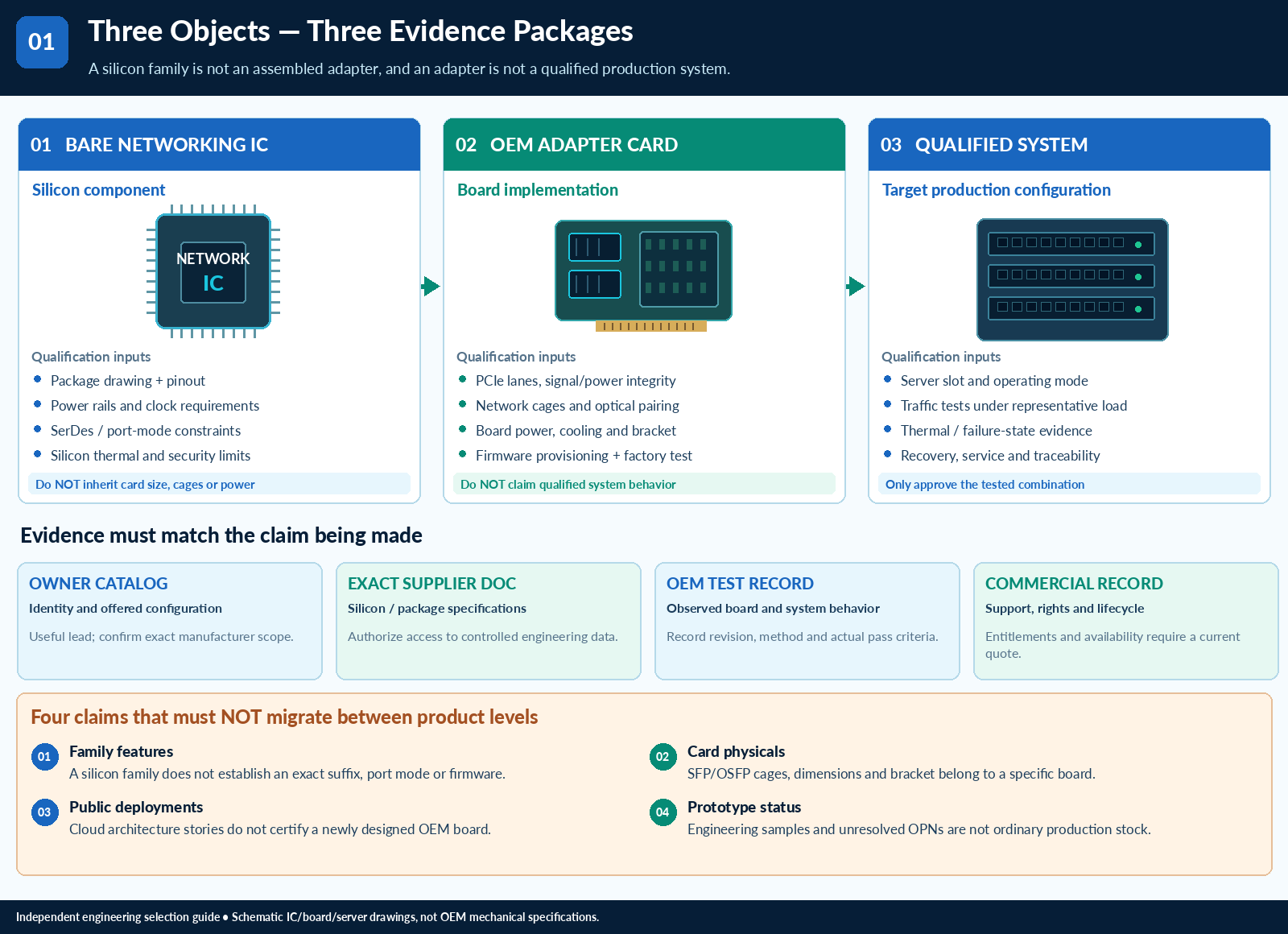
A networking IC purchase begins a different conversation from an adapter-card purchase. A chip family can appear in a successful system while a proposed board design still has substantial qualification work ahead of it.
This guide is a proposed OEM selection workflow. It contains no claim that a specific bare IC was deployed by a named customer or is immediately available for sale.
Establish the identity of the offered item
Start with the complete manufacturer order code and the package or revision it identifies. Request the authorized technical documentation and confirm the intended commercial channel. Keep silicon, finished adapter cards, system-specific modules and accessories in separate bill-of-materials categories.
Record the evidence behind every important field. A public family description may explain an application area, while the exact ordering documentation establishes what the offered item actually is. An unresolved suffix should stay unresolved.
Define the board-level qualification scope
The engineering owner should document the required host interface, port implementation, power budget, thermal solution, firmware provisioning, manufacturing test and service procedure. Agree which responsibilities belong to the chip supplier, board designer, contract manufacturer and system integrator.
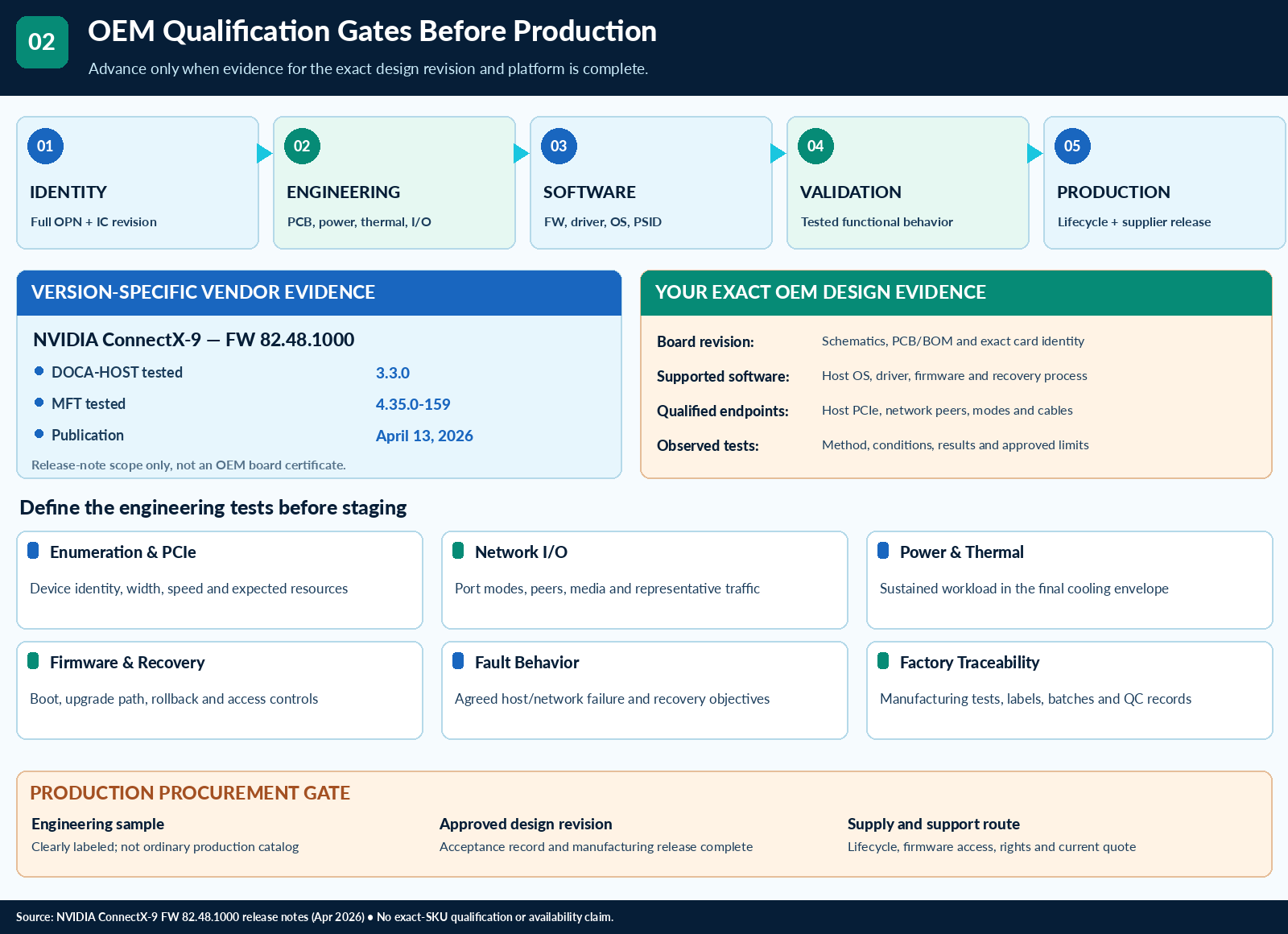
Set measurable acceptance criteria before committing to a volume plan. Include device enumeration, interface behavior, traffic tests, thermal conditions and recovery from the failures the product is expected to handle.
These are qualification work items, not assertions that every IC in a family exposes the same interfaces or features.
Treat software support as versioned evidence
NVIDIA’s ConnectX-9 release documentation lists tested software and firmware combinations. This illustrates why a compatibility statement needs a version and a defined device scope. It should not be expanded into an unconditional promise across all cards or custom boards. Version-specific firmware compatibility
Ask how the proposed design will obtain supported firmware, preserve its device identity and remain serviceable through updates. Confirm the licensing and support arrangements through the appropriate commercial process.
Use deployment stories at the right level
A published cloud deployment can demonstrate demand for a networking architecture. It cannot prove the reliability, compliance or manufacturability of a new OEM board. Keep any family-level story in a background section, with the board’s own test results in the qualification section.
Close the procurement gate
Before production ordering, require an approved design revision, completed acceptance record, verified lifecycle status and a documented supply-and-support route. Keep prototypes, engineering samples and unresolved codes outside the standard production catalog until their status is established.
This discipline makes chip-level content useful to an engineering buyer without borrowing guarantees from an unrelated finished system.
Sources checked: 10 October 2026. This article discusses third-party evidence or an explicitly labeled engineering scenario; it does not establish a reseller’s delivery history, current stock or exact-SKU deployment.
Technical illustrations