
Optical interconnects
100G CWDM4 or LR4: which fits the actual single-mode channel?
Use distance, loss, receive power and FEC to distinguish two duplex-LC candidates.
A short campus or data-center route can still have a demanding patching budget. Reach labels alone do not choose the better duplex single-mode optic.
The short answer
Compare both candidate PMDs against the measured channel and the exact hosts. CWDM4 and LR4 are different optical interfaces, so choose matching interoperable endpoints and apply each model’s FEC requirements.
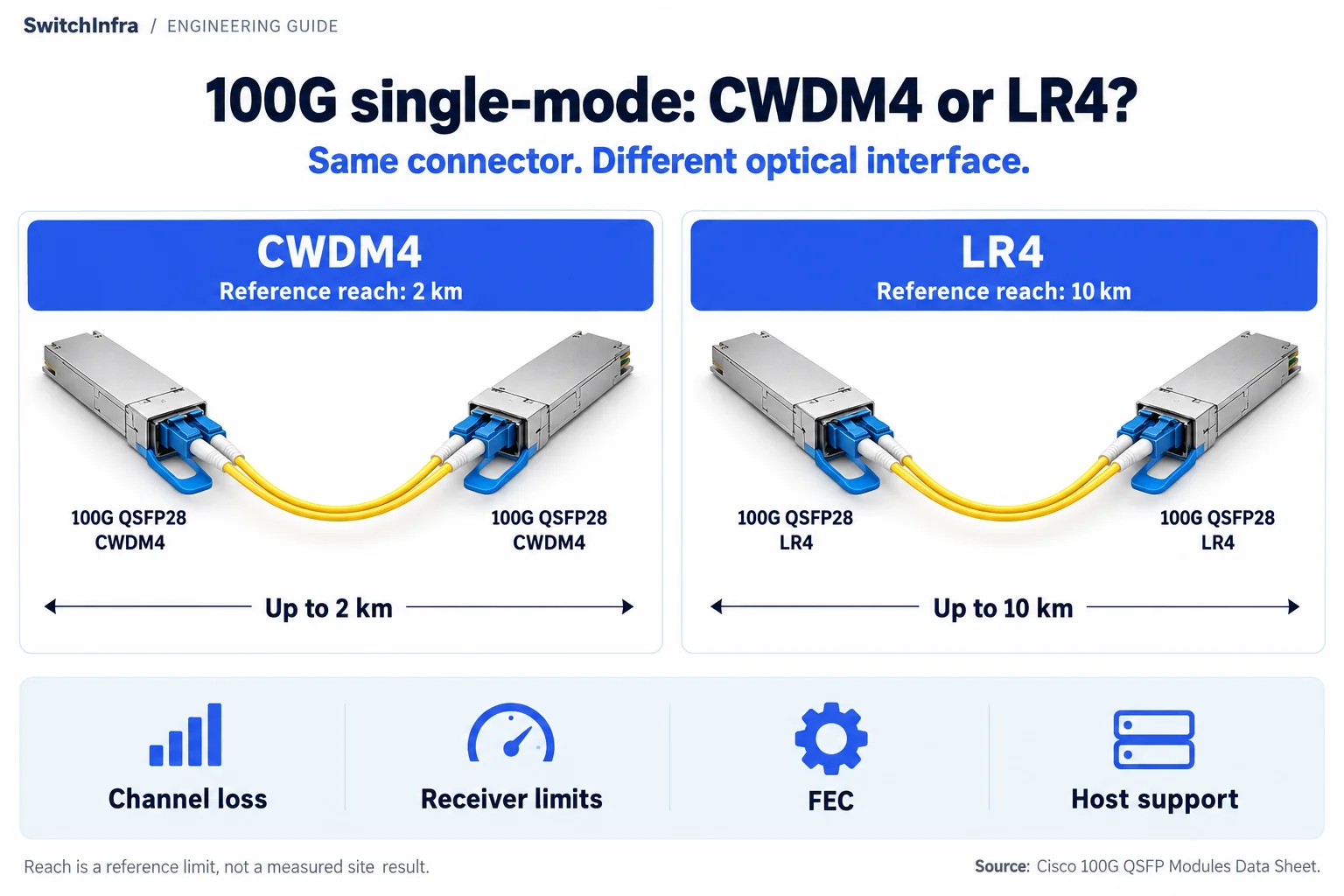
CWDM4 and LR4 are different optical applications. Select compatible endpoints and use the relevant reach, channel loss and host requirements. Conceptual illustration; equipment shapes are illustrative.
Official technical sources · Independent analysis by SwitchInfra
This is a documented design analysis, not a customer deployment claim. Candidate roles require verification for your configuration.
2 km — CWDM4 reference reach
10 km — LR4 reference reach
2 fibers — duplex equipment connection
2 limits — sensitivity and overload
What the technical reference establishes
Cisco lists QSFP-100G-CWDM4-S and QSFP-100G-LR4-S as duplex-LC single-mode options. Its FEC summary distinguishes CWDM4’s RS-FEC from LR4’s no-FEC entry.
The independent exercise is to choose the smallest justified optical solution that supports the complete channel and operating plan. Neither a longer reach nor a stronger transmitter is a universal upgrade.
CWDM4 — A candidate for a suitable channel within its specified reach.
LR4 — A separate PMD with its own optical and host conditions.
FEC — Use the requirements of the exact selected optic.
Channel — Actual distance, loss and patching are project inputs.
Scope of the analysis: Independent engineering analysis of official documentation. The design exercises are illustrative; this guide does not describe a customer deployment.
Work through the engineering choices
Start with the documented constraint, then state the conditions for the proposed equipment role.
Turn the patch schedule into a loss budget
The data sheet provides different specifications for each candidate.
Design exercise: Design exercise: compare two designs using the same duplex fiber route.
List the fiber route, patch cords, cassette assemblies and connector events. Calculate a proposed budget from their documented limits, then compare it with measured channel loss. Keep the test wavelength and direction with the result so the number is meaningful for the proposed link.
As an illustrative calculation, 1.0 dB of fiber allowance plus 1.2 dB of connection allowance and 0.5 dB of chosen margin totals 2.7 dB. These are example inputs, not default allowances or a statement that either candidate passes. Compare the result with the full applicable specification.
Review weak-signal and strong-signal cases
CWDM4 and LR4 publish separate transmit and receive specifications.
Design exercise: Design exercise: check both ends of the permitted operating range.
For the weak-signal case, start from minimum transmit power and subtract maximum channel loss. For the strong-signal case, start from maximum transmit power and subtract minimum channel loss. Compare the received range with both sensitivity and maximum permitted receive power, using the same per-lane measurement basis. The applicable tables specify average optical power unless stated otherwise; do not mix average-power values with optical modulation amplitude (OMA) values in the budget.
Do not add an attenuator just because the module is labeled 10 km. Check the exact PID’s minimum-distance information and power limits first. If attenuation is required, include its tolerance and effect on the weak-signal case in the same budget rather than treating it as an uncalculated accessory.
QSFP-100G-CWDM4-S
Duplex single-mode 100G candidate
Check the CWDM4 channel, peer and required host FEC.
QSFP-100G-LR4-S
Duplex single-mode 100G alternative
Check LR4 host support and receive-power limits independently.
Make FEC and the peer part of the order
The Cisco FEC table assigns different requirements to these models.
Design exercise: Design exercise: migrate an existing pair of 100G host ports.
Check both platform compatibility and optic-to-optic interoperability. Two modules with LC connectors and 100G labels can use different wavelength plans or coding assumptions. Ask for the supported host configuration for the chosen peer combination instead of asking whether a module is generally Cisco-compatible.
Record the intended FEC setting and verify it during commissioning. If a replacement module changes PMD, revisit the peer and channel review instead of copying the old settings. Keep any selected software restriction with the BOM so an apparently equivalent spare does not create a different link design.
Cisco FEC summary · Cisco FEC implementation guide · Cisco optics compatibility matrix
A useful single-mode RFQ includes the whole link
Send enough information to decide between alternatives, not a list that implies both should be installed.
Cisco 100G QSFP data sheet · Cisco FEC summary
Channel
Routed length, assembly schedule and measured loss in each direction.
Endpoints
Both host models, software and peer optical PMD.
Budget
Receive-power range, applicable FEC and the proposed operating margin.
Candidate models and selection boundaries
These are conditional model or product-family inquiries for the documented equipment roles. Confirm the required rate and complete channel before finalizing any line.
| Model / family and status | Role and condition |
|---|---|
| QSFP-100G-CWDM4-S Conditional model inquiry | Duplex single-mode 100G candidate Check the CWDM4 channel, peer and required host FEC. Cisco 100G QSFP data sheet |
| QSFP-100G-LR4-S Conditional model inquiry | Duplex single-mode 100G alternative Check LR4 host support and receive-power limits independently. Cisco 100G QSFP data sheet |
| QSFP-100G-CU3M-RF (Cisco Refresh, remanufactured) Different direct-connect role | Separate 3 m copper direct connection Excluded from a structured optical channel; not a fiber replacement. Cisco 100G QSFP data sheet |
The CWDM4 and LR4 models were not found in targeted public catalog checks and remain model inquiries. Product 7531 is a separately listed 3 m DAC, not an optical substitute; supply remains on request.
Continue in the relevant product family
Use the analysis to define the role before comparing catalog options.
Discuss this project
Carry the route, media, endpoint and loss requirements into the inquiry. Leave unknown quantities blank; reference port and fiber counts are not an equipment BOM.
Follow the next selection question.
Compare related decisions while keeping each source’s scope, hardware and link conditions separate.
Browse more engineering analyses →
25G migration: select the operating mode
Match NIC capability, optical media and FEC before changing server link rates.
Read the engineering analysisOfficial technical source
40G breakout: a suffix can change the design
Check the host configuration and exact optical model before buying four 10G paths.
Read the engineering analysisOfficial technical source
MPO trunk, LC front: identify the actual 40G path
A practical channel map prevents a connector match from becoming an optical mismatch.
Read the engineering analysisOfficial technical source
Before you finalize the channel
Are CWDM4 and LR4 automatically interoperable?
No. Verify the exact optical pairing; equal rate and connector are insufficient.
Does 10 km reach mean it needs attenuation in every rack?
No. Calculate the actual receive-power range first.
Can a DAC traverse a patch panel?
The listed copper DAC provides a separate direct connection.
Does a passing loss value prove host support?
No. Optical-channel and host compatibility are separate checks.
Trace the project facts and technical limits
- Cisco 100G QSFP data sheet
- Cisco FEC summary
- Cisco FEC implementation guide
- Cisco optics compatibility matrix
Source check: 19 October 2026. Catalog status is stated per candidate.
Official sources checked 19 October 2026. Final host, software, channel and offered-unit compatibility require project-specific verification.