
Optical interconnects
MPO–LC cassette or parallel SR4: what does the 40G channel actually present?
A practical channel map prevents a connector match from becoming an optical mismatch.
Two cabinets can use the same style of MPO trunk and still need different optics. The equipment-facing path determines whether the link is duplex or parallel.
The short answer
Draw the complete channel through both panels. An MPO-to-LC cassette can form duplex ports; it does not turn those ports into a parallel SR4 channel or change the fiber’s media type.
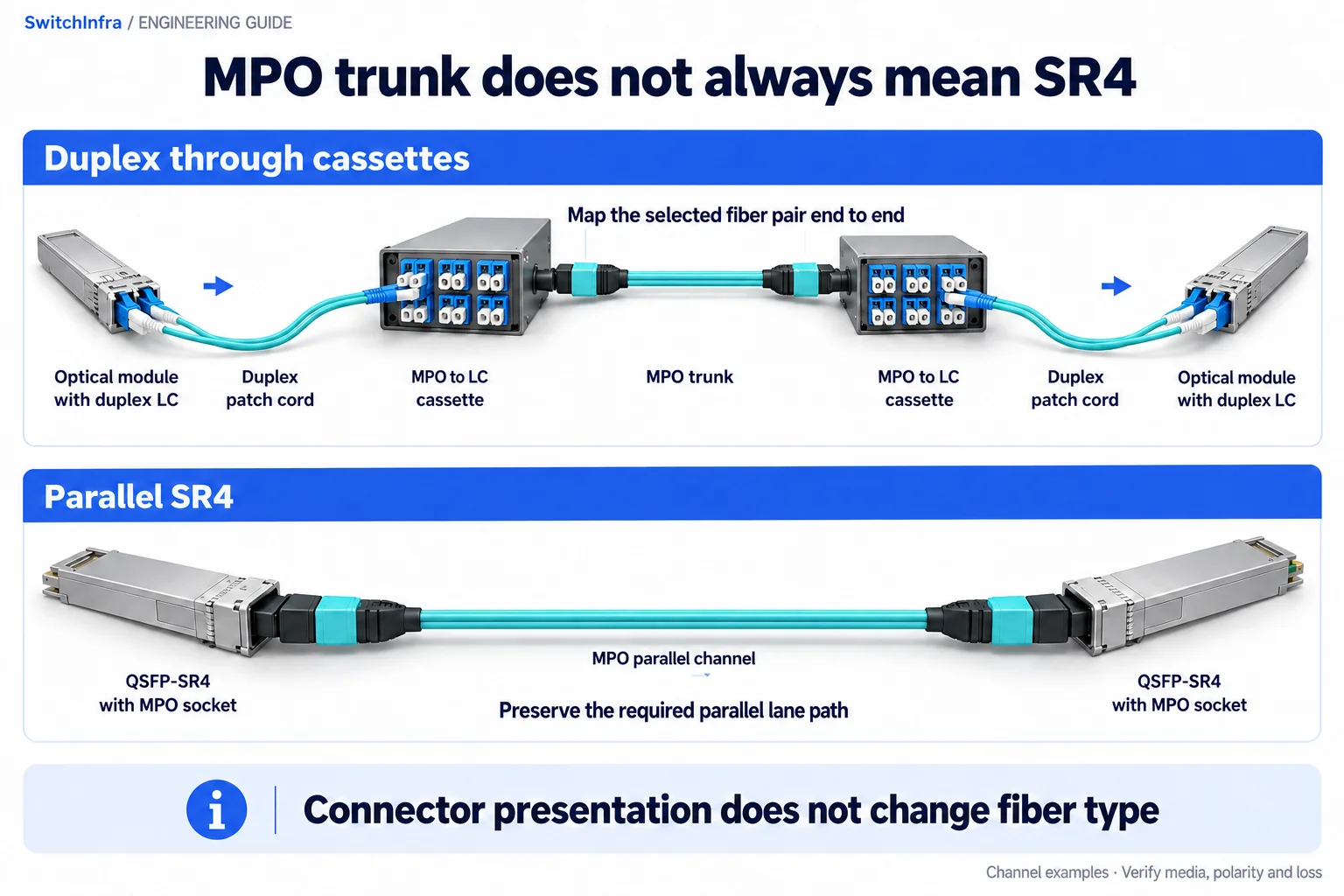
MPO-to-LC cassettes can present duplex channels; parallel SR4 requires its own lane mapping. Connector presentation does not change the fiber type. Conceptual illustration; equipment shapes are illustrative.
Official technical sources · Independent analysis by SwitchInfra
This is a documented design analysis, not a customer deployment claim. Candidate roles require verification for your configuration.
2 ends — must be mapped together
Duplex — and parallel are different paths
MPO ≠ PMD — connector alone is insufficient
Loss — includes every assembly
What the technical reference establishes
CommScope’s ordering guide lists MPO cassettes with LC interfaces, including single-mode and multimode options. Its separate fanout documentation also demonstrates that multifiber trunks can terminate in LC equipment connections.
The purchasing question is therefore not whether the rack contains MPO. It is which fibers and connectors connect the actual transmitters to receivers after all cassettes, adapters and patch cords are included.
CommScope NETCONNECT ordering guide, page 8
Documented option — MPO cassettes can provide duplex LC ports.
Media — Single-mode and multimode assemblies are distinct.
Optical role — A connector format does not identify the PMD.
Site input — Installed mappings, length and loss remain project-specific.
Scope of the analysis: Independent engineering analysis of official documentation. The design exercises are illustrative; this guide does not describe a customer deployment.
Work through the engineering choices
Start with the documented constraint, then state the conditions for the proposed equipment role.
Inventory the assemblies before selecting the optic
The guide lists cassette formats with LC ports.
Design exercise: Design exercise: two panels connected by an existing multifiber trunk.
Create a channel drawing with a separate box for every cassette and adapter. Copy the assembly part numbers and the connector position schedule, rather than assuming that similarly colored housings contain the same fiber. Ask for continuity results when labels and records disagree.
Count available equipment ports after the mapping is known. As an arithmetic example, twelve fibers arranged as pairs provide six duplex paths; that is not twelve duplex links. A different cassette can allocate the same trunk differently, so fiber inventory and service-port inventory belong on separate BOM lines.
CommScope NETCONNECT ordering guide, page 8 · CommScope single-mode MPO-to-LC fanout
Choose the optical architecture that matches that path
Cisco documents duplex and parallel 40G optical options.
Design exercise: Conditional choice: duplex single-mode versus parallel multimode.
If the installed path provides duplex single-mode LC, evaluate a suitable duplex single-mode PMD. If a parallel multimode SR4 design is desired, establish the required lane path to its equipment-facing MPO interface. A passive cassette changes the physical presentation; it does not convert a single-mode channel into multimode.
Do not solve a mismatch by ordering a connector adapter alone. Check the media, lane positions, polarity and required mating arrangement together. Compare the cost of using the existing duplex channel with the operational cost of rebuilding the patching path, leaving exact part compatibility conditional until the host ports are known.
QSFP-40G-SR4
Parallel multimode 40G path
Only where the end-to-end channel presents the required parallel interface.
QSFP-40G-SR4-S
Native parallel 40G alternative
Not a 4 × 10G breakout candidate.
QSFP-40G-LR4-S
Duplex single-mode 40G path
Evaluate only on a suitable single-mode channel and supported hosts.
Budget loss for the proposed arrangement
Cassette and fanout assemblies are separate channel components.
Design exercise: Design exercise: compare a short direct path with one using two distribution panels.
Write the proposed loss budget as fiber attenuation plus the specified loss of each connection and assembly, with an explicitly chosen operating margin. Use the actual manufacturer limits and test method; a short physical route can still contain several connection events.
Before accepting the BOM, require an end-to-end test record tied to the same fiber positions used in the drawing. A successful continuity test proves the path exists, while a loss test addresses a different question. Keep the tested channel version alongside the optic and switch revisions so later repatching does not silently invalidate the selection.
CommScope NETCONNECT ordering guide, page 8 · Cisco optics compatibility matrix
What to send with the inquiry
Attach the channel drawing and request a matched optical-path review.
CommScope NETCONNECT ordering guide, page 8 · Cisco 40G QSFP data sheet
Physical map
Both cassette part numbers, trunk format, lane positions and polarity.
Optical evidence
Fiber grade, connectors, routed length and measured loss.
Equipment
Both host ports, software and intended native-link mode.
Candidate models and selection boundaries
These are conditional model or product-family inquiries for the documented equipment roles. Confirm the required rate and complete channel before finalizing any line.
| Model / family and status | Role and condition |
|---|---|
| QSFP-40G-SR4 Conditional model inquiry | Parallel multimode 40G path Only where the end-to-end channel presents the required parallel interface. Cisco 40G QSFP data sheet |
| QSFP-40G-SR4-S Conditional model inquiry | Native parallel 40G alternative Not a 4 × 10G breakout candidate. Cisco 40G QSFP data sheet |
| QSFP-40G-LR4-S Conditional model inquiry | Duplex single-mode 40G path Evaluate only on a suitable single-mode channel and supported hosts. Cisco 40G QSFP data sheet |
All three optical models remain model inquiries. Targeted public catalog checks found no exact listings; no stock or complete host compatibility is established.
Continue in the relevant product family
Use the analysis to define the role before comparing catalog options.
Discuss this project
Carry the route, media, endpoint and loss requirements into the inquiry. Leave unknown quantities blank; reference port and fiber counts are not an equipment BOM.
Follow the next selection question.
Compare related decisions while keeping each source’s scope, hardware and link conditions separate.
Browse more engineering analyses →
40G breakout: a suffix can change the design
Check the host configuration and exact optical model before buying four 10G paths.
Read the engineering analysisOfficial technical source
100G single-mode: select with a budget
Use distance, loss, receive power and FEC to distinguish two duplex-LC candidates.
Read the engineering analysisOfficial technical source
25G migration: select the operating mode
Match NIC capability, optical media and FEC before changing server link rates.
Read the engineering analysisOfficial technical source
Before you finalize the channel
Is every MPO link a parallel optical link?
No. It can be a multifiber trunk feeding duplex cassette ports.
Does an LC port mean single-mode?
No. LC can appear on different media and PMDs; verify both.
Can a cassette fix an unsupported optic?
No. Host support and optical interoperability remain separate checks.
Should panel fiber density determine switch quantity?
No. Count usable link paths and endpoint ports after mapping.
Trace the project facts and technical limits
- CommScope NETCONNECT ordering guide, page 8
- CommScope single-mode MPO-to-LC fanout
- Cisco 40G QSFP data sheet
- Cisco optics compatibility matrix
Source check: 19 October 2026. Catalog status is stated per candidate.
Official sources checked 19 October 2026. Final host, software, channel and offered-unit compatibility require project-specific verification.