
Optical interconnects
Moving servers from 10G to 25G: match the NIC, optics and FEC
Match NIC capability, optical media and FEC before changing server link rates.
A server upgrade can preserve the fiber route while changing its optical limits. Treat 25G as a new endpoint and channel review, even when the connector remains LC.
The short answer
Confirm the NIC and switch port at 25G, then select the exact optic and matching FEC. Dual-rate modules can support a staged migration, but neither the module name nor the SFP-shaped cage guarantees both operating modes.
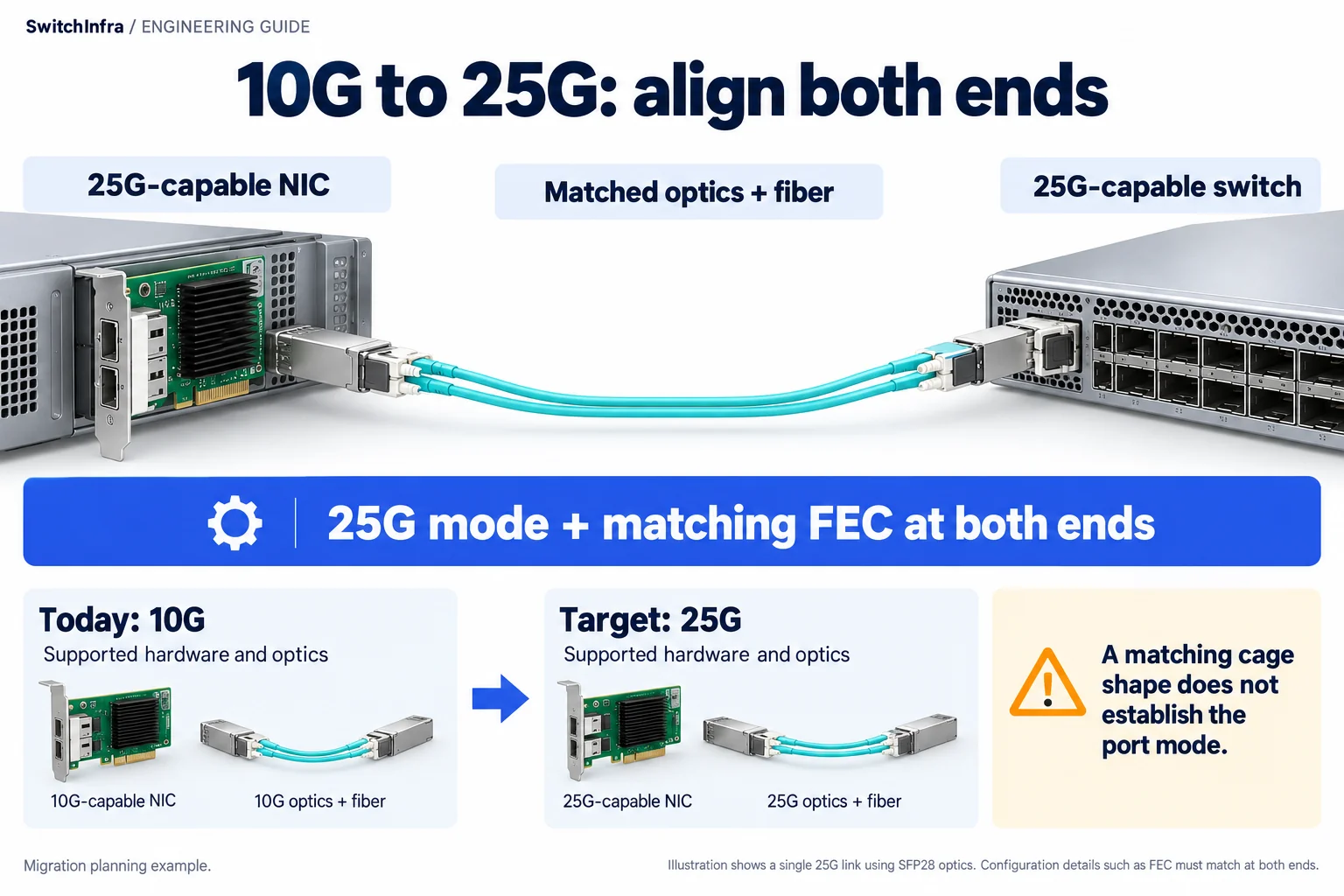
A 25G migration requires agreement between the NIC, switch port, optics or cable, and supported FEC settings. Conceptual illustration; equipment shapes are illustrative.
Official technical sources · Independent analysis by SwitchInfra
This is a documented design analysis, not a customer deployment claim. Candidate roles require verification for your configuration.
10 → 25G — 2.5× nominal port rate
RS-FEC — required for the cited SR optic
70 / 100 m — SR reference reach on OM3 / OM4
2 endpoints — must support the chosen mode
What the technical reference establishes
Cisco’s SFP28 data sheet specifies RS-FEC for SFP-25G-SR-S. It also documents dual-rate CSR and LR models, whose media and operating conditions differ.
A practical migration order should separate server groups that can change now from hosts remaining at 10G. That schedule determines whether dual-rate modules provide a useful operational benefit rather than simply adding another SKU.
Port — A 25G service needs supported endpoint hardware.
Media — SR and CSR use multimode; LR uses single-mode.
Rate transition — Dual-rate operation is model-specific.
Demand — Faster NIC capacity does not establish application throughput.
Scope of the analysis: Independent engineering analysis of official documentation. The design exercises are illustrative; this guide does not describe a customer deployment.
Work through the engineering choices
Start with the documented constraint, then state the conditions for the proposed equipment role.
Group servers by the link they can actually run
Cisco documents rate-specific SFP28 interfaces.
Design exercise: Design exercise: migrate one rack while retaining several 10G endpoints.
Inventory the NIC model, firmware, operating system support, switch port and peer optic for each host. Divide the migration into confirmed 25G, retained 10G and unresolved endpoints. The resulting port schedule prevents a 25G optic order from being mistaken for an upgrade to a fixed-rate 10G adapter.
Size the shared uplinks separately. For example, twenty-four 25G access ports total 600 Gbps of nominal one-direction capacity; two usable 100G uplinks total 200 Gbps, giving a simple 3:1 ratio before other constraints. This arithmetic is a planning comparison, not a prediction of congestion or a measured throughput result.
Cisco 25GE and 100GE migration white paper · Cisco Nexus FX3 platform data sheet
Choose the optical mode and FEC together
The cited 25G SR module requires RS-FEC.
Design exercise: Conditional choice: short multimode, dual-rate multimode or duplex single-mode.
Check reach at the intended operating rate. Reusing a route that worked at 10G does not establish that it passes at 25G. Compare the installed fiber grade and measured channel loss with the selected model’s specification, including the host’s supported FEC setting.
For a staged link, document the proposed settings at both 10G and 25G. The dual-rate CSR model has different reach behavior under different FEC choices; Cisco also warns that SFP-10/25G-CSR-S paired with an IEEE 10G-SR receiver may overload that receiver. Check the exact pairing in the optics-to-optics interoperability matrix before using it. Do not assume “auto” will make every old and new endpoint combination safe.
Cisco 25G SFP28 data sheet · Cisco optics compatibility matrix
SFP-25G-SR-S
25G multimode candidate
Verify RS-FEC and the shorter 25G multimode reach.
SFP-10/25G-CSR-S
Dual-rate multimode migration candidate
Rate, FEC, reach and peer interoperability require separate review.
SFP-10/25G-LR-S
Dual-rate single-mode candidate
Verify the single-mode channel and 25G RS-FEC.
Migrate a service, then verify its shared path
The platform data sheet distinguishes access and uplink roles.
Design exercise: Design exercise: move a small agreed host group before the remaining rack.
Validate link establishment, FEC counters and error behavior using a defined test window. Then exercise the application path through the selected uplinks. A higher local link rate is useful evidence about that port, but it does not prove that storage, host processing or upstream capacity can deliver the same increase.
Keep the fallback settings and the 10G peer parts identified until the agreed validation is complete. Order the migration group, spares and later capacity separately so a mixed-rate rack remains understandable to operations. Include every required module at both ends rather than assuming existing peers can stay unchanged.
Cisco Nexus FX3 platform data sheet · Cisco 25GE and 100GE migration white paper
Send a migration matrix with the inquiry
Make current and target rates explicit for each endpoint group.
Cisco 25G SFP28 data sheet · Cisco 25GE and 100GE migration white paper
Endpoints
NIC, firmware, switch port, software and peer model.
Channel
Media, length, loss and optical pairing at both rates.
Operating plan
FEC per rate, uplink allocation, migration groups and fallback parts.
Candidate models and selection boundaries
These are conditional model or product-family inquiries for the documented equipment roles. Confirm the required rate and complete channel before finalizing any line.
| Model / family and status | Role and condition |
|---|---|
| SFP-25G-SR-S Conditional model inquiry | 25G multimode candidate Verify RS-FEC and the shorter 25G multimode reach. Cisco 25G SFP28 data sheet |
| SFP-10/25G-CSR-S Conditional model inquiry | Dual-rate multimode migration candidate Rate, FEC, reach and peer interoperability require separate review. Cisco 25G SFP28 data sheet |
| SFP-10/25G-LR-S Conditional model inquiry | Dual-rate single-mode candidate Verify the single-mode channel and 25G RS-FEC. Cisco 25G SFP28 data sheet |
| N9K-C93180YC-FX3 Conditional listed platform | SFP28 access platform candidate Confirm the actual NIC, module, release, uplinks and power/airflow bundle. Cisco Nexus FX3 platform data sheet |
Targeted public checks found no exact listing for the three optical models; they remain model inquiries. N9K-C93180YC-FX3 is listed as 7512, on request; it is not a verified NIC/optic bundle.
Continue in the relevant product family
Use the analysis to define the role before comparing catalog options.
Discuss this project
Carry the route, media, endpoint and loss requirements into the inquiry. Leave unknown quantities blank; reference port and fiber counts are not an equipment BOM.
Follow the next selection question.
Compare related decisions while keeping each source’s scope, hardware and link conditions separate.
Browse more engineering analyses →
100G single-mode: select with a budget
Use distance, loss, receive power and FEC to distinguish two duplex-LC candidates.
Read the engineering analysisOfficial technical source
40G breakout: a suffix can change the design
Check the host configuration and exact optical model before buying four 10G paths.
Read the engineering analysisOfficial technical source
MPO trunk, LC front: identify the actual 40G path
A practical channel map prevents a connector match from becoming an optical mismatch.
Read the engineering analysisOfficial technical source
Before you finalize the channel
Does every SFP+ port accept 25G?
No. Check the host port’s supported rates and module compatibility.
Can the old 10G reach be reused as the 25G limit?
No. Apply the selected module’s specification at the target rate.
Does dual-rate mean automatic interoperability?
No. Both endpoints and their rate-specific optical behavior need review.
Will a 25G NIC make an application 2.5× faster?
That is a nominal rate comparison; application performance depends on the complete system.
Trace the project facts and technical limits
- Cisco 25G SFP28 data sheet
- Cisco 25GE and 100GE migration white paper
- Cisco Nexus FX3 platform data sheet
- Cisco optics compatibility matrix
Source check: 19 October 2026. Catalog status is stated per candidate.
Official sources checked 19 October 2026. Final host, software, channel and offered-unit compatibility require project-specific verification.