
Campus networks
How should four new schools separate access ports, fiber uplinks and powered endpoints?
Build site-specific data, powered-device and single-mode aggregation rows from a broad campus scope.
A shared school construction package does not imply one interchangeable switch for classrooms, cameras and building uplinks. Separate service roles before turning information outlets into equipment quantities.
The short answer
Count ordinary data ports, powered devices and fiber uplinks independently at each school. Verify the copper channel and single-mode backbone, then size uplinks from real simultaneous traffic.
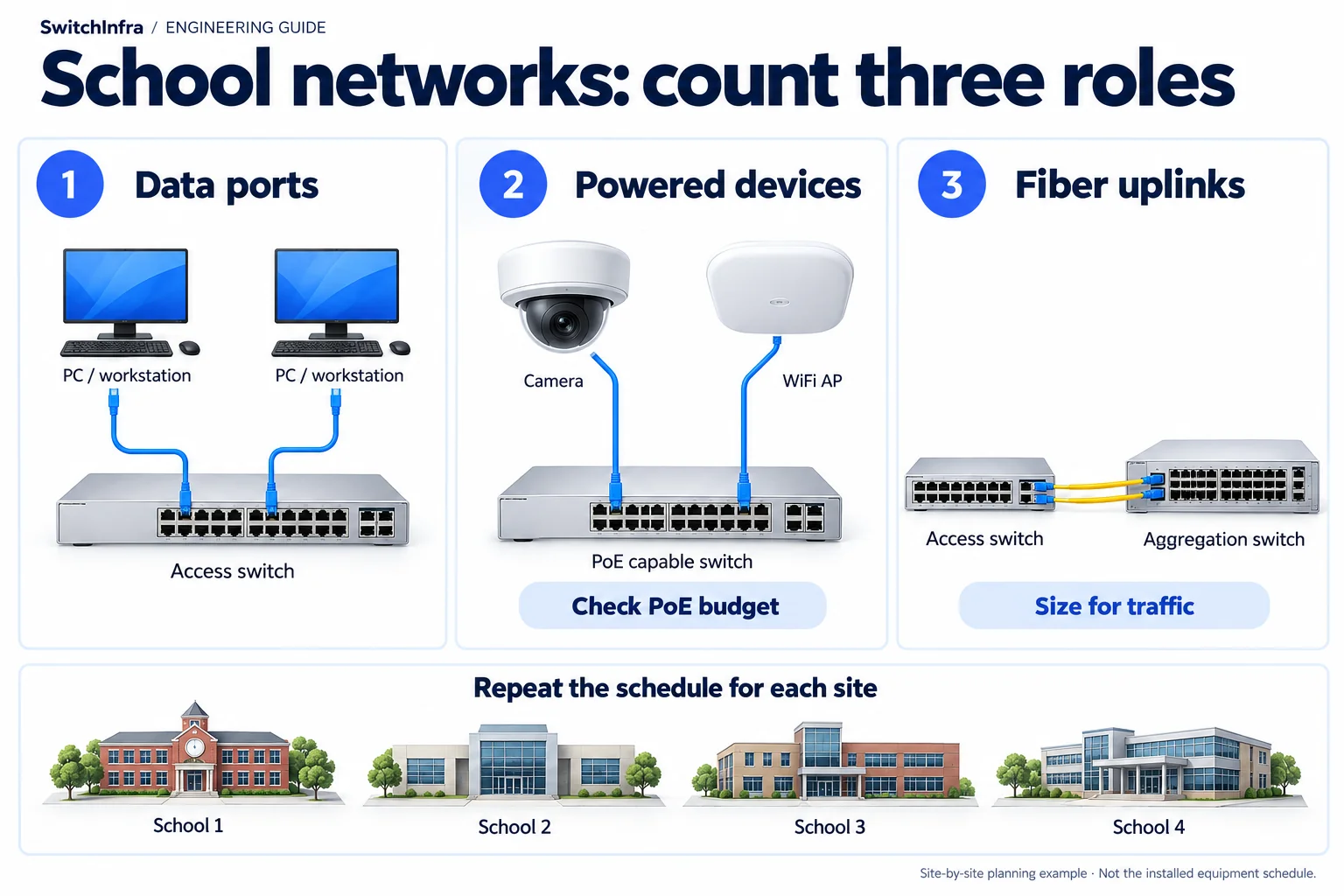
Count data ports, PoE-powered devices and fiber uplinks separately, and repeat the schedule for each school. Conceptual illustration; equipment shapes are illustrative.
Third-party project account · Independent analysis by SwitchInfra
Not a SwitchInfra deployment. Candidate equipment is proposed for comparable requirements.
4 schools — reported construction package
16 systems — reported campus service scope
Cat 6 — reported horizontal copper
SMF — reported vertical backbone
What the documented project tells us
iCONEC’s account names four Luoyang schools and a 16-system campus program. It reports Cat 6 unshielded horizontal cabling, single-mode vertical cabling and low-smoke, halogen-free jackets.
The article does not publish switch models or service rates. For a comparable rollout, the engineering task is to convert that mixed service scope into distinct access, power and uplink requirements for each building.
iCONEC, republished by Qianjia project account
Sites — Jiqing, Lantai, Fengli and Huayuan schools are named.
Services — The package covers 16 campus subsystems.
Horizontal links — Cat 6 unshielded copper cabling is reported.
Vertical links — Single-mode optical cabling is reported.
Scope of the analysis: Public project analysis of a third-party supplier account. Not a SwitchInfra deployment or independent acceptance report. Every proposed rate and model below is a separate design exercise.
Work through the engineering choices
Start with the documented constraint, then state the conditions for the proposed equipment role.
Count endpoint roles instead of treating outlets alike
The project includes teaching, surveillance, access control and other systems.
Design exercise: Design exercise: create a room-level service and power schedule.
For each outlet, identify the connected device, required rate and whether it needs power through Ethernet. Count spare outlets separately from active endpoints. A camera, display controller and ordinary desktop can share a cabling category while requiring different switch features and power arrangements.
C9200L-24T-4G-E is a conditional example for ordinary 1G data access, with 24 copper data ports and four fixed 1G SFP uplinks. It is not a PoE selection for powered devices, nor a 10G uplink platform. Do not apply it across the package merely because it fits a room’s port count.
Cisco Catalyst 9200 series data sheet
Keep each school’s traffic budget local and explicit
The source describes four schools without a port-level topology.
Design exercise: Design exercise: size a building uplink from an endpoint schedule.
Group expected concurrent traffic by service, then identify which flows stay inside the school and which leave the building. Consider busy teaching periods and simultaneous recording or video traffic. Do not infer a shared inter-school backbone or a particular oversubscription ratio from the procurement package.
Select uplink capacity only after this traffic profile is agreed. If a 10G single-mode connection is justified, assess SFP-10G-LR with the correct host port. A switch limited to 1G SFP uplinks cannot acquire 10G capability by accepting a differently shaped or higher-rated procurement line.
Cisco 10G optical module data sheet · Cisco Catalyst 9200 series data sheet
Verify the backbone beyond its single-mode label
The supplier reports single-mode vertical cabling.
Design exercise: Conditional examples: independent 10G or 40G building aggregation.
Request the fiber grade, equipment-facing interfaces, actual routed distance, patching map and measured loss for every building path. Record whether any MPO trunk ends in LC cassettes. Both the physical channel and the two host platforms must support the selected PMD.
SFP-10G-LR and QSFP-40G-LR4-S illustrate different equipment and rate requirements, not interchangeable upgrades. The latter uses a QSFP+ role and needs suitable 40G hosts; its published minimum distance and power limits still apply. Neither model is identified as installed in the four schools.
Cisco 10G optical module data sheet · Cisco 40G optical module data sheet · Cisco optics compatibility matrix
Return one school-specific BOM per service role
A common specification can reduce purchasing friction, but quantities and power budgets remain site-specific. Require the quotation to show which rows serve data-only endpoints, powered devices and building aggregation.
Cisco optics compatibility matrix
Access
Active device counts, spare outlets, PoE classes and switch power budgets.
Aggregation
Concurrent traffic, uplink rates and both host port inventories.
Fiber
Actual termination map, distance and measured channel loss by building.
Candidate models and selection boundaries
These are illustrative model inquiries, not the equipment installed in the source project. Confirm the required rate and complete channel before finalizing any line.
| Model / family and status | Role and condition |
|---|---|
| C9200L-24T-4G-E Conditional catalog candidate | Conditional 1G data-only access No PoE role; fixed 1G SFP uplinks do not meet a 10G uplink need. Cisco Catalyst 9200 series data sheet |
| SFP-10G-LR Conditional model inquiry | Independent 10G SMF uplink Requires a suitable 10G host, not the above switch’s 1G uplink. Cisco 10G optical module data sheet |
| QSFP-40G-LR4-S Conditional model inquiry | Independent 40G SMF aggregation Only if traffic and both QSFP+ hosts justify this rate. Cisco 40G optical module data sheet |
Listed models are independent design candidates, not equipment identified in this project. IDs are supplied only for previously verified exact catalog matches. Other PIDs are model inquiries; supply and platform compatibility are unconfirmed.
Continue in the relevant product family
Use the analysis to define the role before comparing catalog options.
Network Modules and Line Cards
Discuss this project
Carry the route, media, endpoint and loss requirements into the inquiry. Leave unknown quantities blank; source-project fiber counts are not an equipment BOM.
Follow the next selection question.
Compare related decisions while keeping each source’s scope, hardware and link conditions separate.
Browse more engineering analyses →
24-fiber MTP: one allocation, different optical choices
Map custom cassettes before selecting native 40G, duplex 10G or an independently proposed breakout design.
Read the engineering analysis · Original project account
Campus OS2: qualify both routes before choosing optics
Use Newcastle’s Catalyst Building account to examine per-route channel budgets and protection requirements. The installed link rates remain undisclosed.
Read the engineering analysis · Original project account
Campus ring: count channels across the ODF
Translate a university distribution project into route, pair and protection requirements before choosing optics.
Read the engineering analysis · Original project account
Before you finalize the channel
Does Cat 6 establish a 10G access design?
No. The case does not disclose application speed or channel test results. Validate the required application against the actual installed channel.
Can all cameras use the data-only switch example?
Only if power is provided separately and all other requirements are met. A PoE requirement needs an explicitly suitable power-capable platform.
Does one construction package prove the schools share a network?
No. The source identifies the package scope but does not publish its inter-school topology.
What should the RFQ separate?
Provide per-school endpoint roles, power requirements, traffic estimates, uplink host details and measured optical-channel information.
Trace the project facts and technical limits
- iCONEC, republished by Qianjia project account
- Cisco Catalyst 9200 series data sheet
- Cisco 10G optical module data sheet
- Cisco 40G optical module data sheet
- Cisco optics compatibility matrix
Source check: 19 October 2026. Catalog status is stated per candidate.
Sources checked 19 October 2026. Service speeds, active topology and equipment models remain unverified. Catalog presence does not confirm supply or project compatibility.