
Optical interconnects
Can a 100G QSFP28 port replace a native 40G connection?
Keep native links and breakout endpoints separate in the port schedule.
A similar front-panel opening can hide different operating rates. Upgrading the switch does not turn the old 40G peer into a 100G endpoint.
The short answer
A suitable multi-rate host can run a supported 40G connection, or a separate native 100G design. Breakout creates supported lower-rate interfaces; it is not a general speed-conversion function and cannot be inferred from the optic’s form factor.
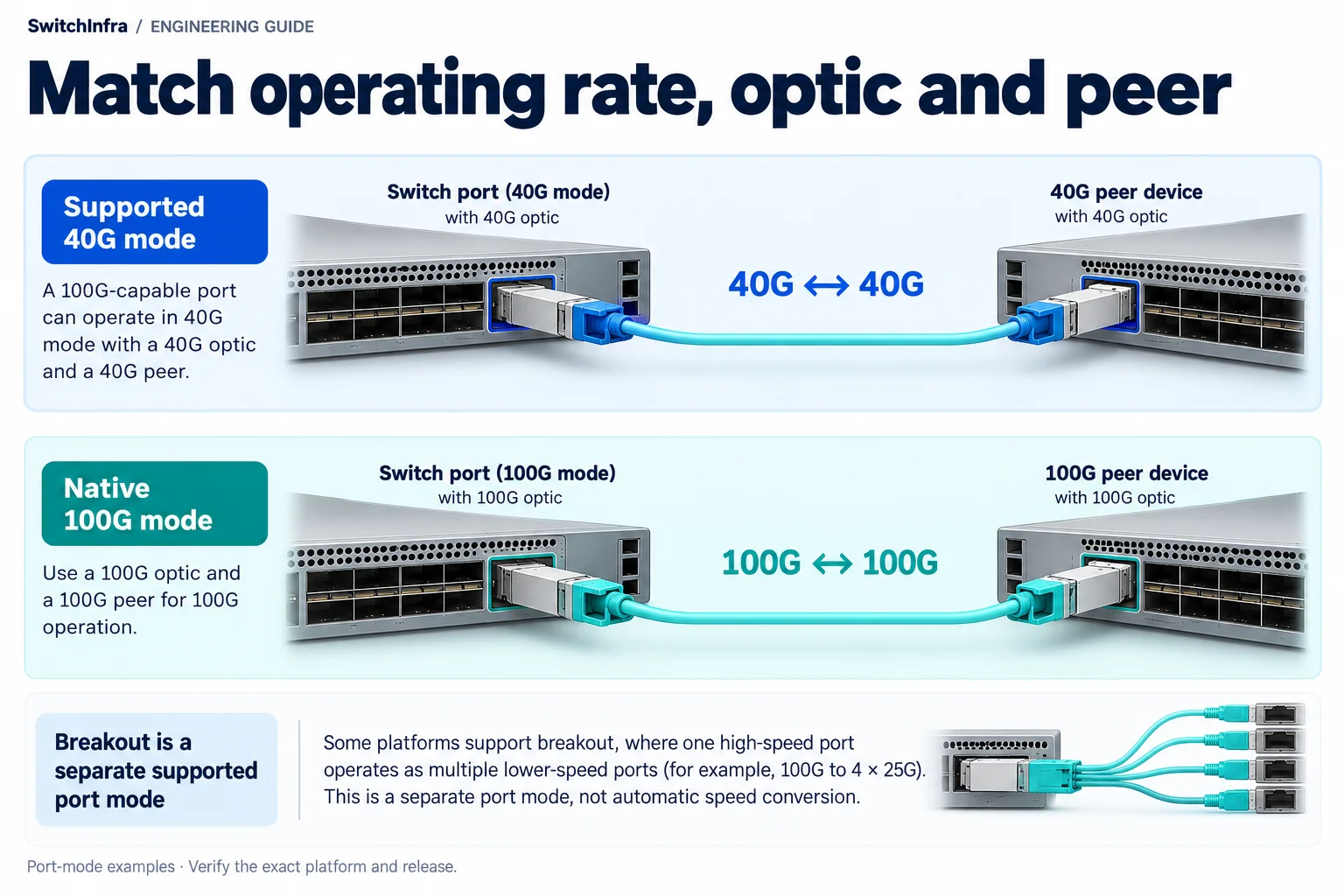
Use a supported operating mode with matching optics and peers. Breakout is a separate supported configuration, not automatic rate conversion. Conceptual illustration; equipment shapes are illustrative.
Official technical sources · Independent analysis by SwitchInfra
This is a documented design analysis, not a customer deployment claim. Candidate roles require verification for your configuration.
Native — one rate-matched service
Breakout — separate child interfaces
Peer — must match the intended mode
PMD — remains an independent choice
What the technical reference establishes
The NX-OS 10.6 guide lists several breakout modes for the Nexus FX3 platform. The FX3 data sheet also identifies 40G/100G-capable uplink ports.
Those capabilities create design options, not one universal cable solution. Review a mixed-generation connection as an endpoint pair and explicitly decide which rate each end will run before buying the optical or copper assembly.
Cisco NX-OS 10.6 breakout support matrix
Host capability — Port-mode support depends on the exact platform and software.
Module capability — A supported cage does not imply every optical mode.
Fanout — A native cable and a multi-endpoint breakout assembly have different roles.
Configuration — Native and child interfaces need different port schedules.
Scope of the analysis: Independent engineering analysis of official documentation. The design exercises are illustrative; this guide does not describe a customer deployment.
Work through the engineering choices
Start with the documented constraint, then state the conditions for the proposed equipment role.
Choose the common endpoint rate
The platform supports specific native port rates.
Design exercise: Design exercise: replace one switch while retaining an existing 40G peer.
Start with the unchanged peer’s supported rate, PMD and port mode. If the replacement host can support the same approved combination at 40G, that is a candidate migration path. A 100G module at the new end does not solve a fixed-rate 40G mismatch at the far end.
Write the selected rate on both sides of the diagram. Separate any later 100G upgrade into a second design that changes the peer and rechecks the channel. This avoids purchasing a future optic that cannot establish the current service, while still allowing the switch platform to have later capacity.
Cisco Nexus FX3 platform data sheet · Cisco NX-OS 10.6 breakout support matrix
40G/100G host platform candidate
Supported rates and breakout modes do not approve every optic or peer combination.
QSFP-40G-SR4
Native 40G optical candidate
Assess when both endpoints and the multimode channel run the chosen 40G PMD.
Distinguish electrical lanes from optical presentation
The interface guide treats breakout as a host feature.
Design exercise: Design exercise: compare one native uplink with a proposed group of lower-rate endpoints.
Confirm the exact allowed child rates, port restrictions and software release before counting breakout endpoints. A high-speed port must expose the intended logical interfaces, and the selected assembly must connect those interfaces to matching peers. Similar total capacity is not enough to make two lane plans interchangeable.
A duplex wavelength-multiplexed optic is also different from a parallel fiber interface. For example, the LC pair of the listed LR4 candidate cannot be turned into four independent SFP connections by a passive fanout cord. Choose a documented breakout optical or cable arrangement when that is the actual requirement.
Cisco NX-OS 10.6 breakout support matrix · Cisco 100G QSFP data sheet
QSFP-100G-LR4-S
Native 100G duplex single-mode candidate
Not a passive LC-to-four-SFP breakout solution.
QSFP-100G-CU3M-RF (Cisco Refresh, remanufactured)
Native 100G direct copper candidate
3 m direct path; not a four-endpoint fanout assembly.
Count the capacity consumed by the chosen mode
The host guide lists mode-specific interface behavior.
Design exercise: Design exercise: reserve uplinks before assigning spare ports to servers.
Make one row for each physical parent port and show its mode, peer and resulting logical interfaces. Count the parent only once. If it serves child interfaces, remove that same port from the native uplink pool rather than counting its nominal capacity twice.
Assess the remaining design during the intended failure condition as well as normal operation. If the spare port was the recovery path, consuming it for breakout changes the recovery plan. The final BOM should state the exact assembly, length and peers, while the port schedule states what bandwidth remains available for each role.
Cisco NX-OS 10.6 breakout support matrix · Cisco Nexus FX3 platform data sheet
Specify the endpoint pair and the intended mode
A quotation should be tied to the service that must work on installation day.
Cisco NX-OS 10.6 breakout support matrix · Cisco 100G QSFP data sheet
Native service
Both hosts, common rate and supported optical PMD.
Breakout service
Exact child rates, lane mapping, peer ports and platform restrictions.
Capacity plan
Parent-port allocation, remaining uplinks and the failure condition being sized.
Candidate models and selection boundaries
These are conditional model or product-family inquiries for the documented equipment roles. Confirm the required rate and complete channel before finalizing any line.
| Model / family and status | Role and condition |
|---|---|
| N9K-C93180YC-FX3 Conditional listed platform | 40G/100G host platform candidate Supported rates and breakout modes do not approve every optic or peer combination. Cisco NX-OS 10.6 breakout support matrix |
| QSFP-40G-SR4 Conditional model inquiry | Native 40G optical candidate Assess when both endpoints and the multimode channel run the chosen 40G PMD. Cisco 40G QSFP data sheet |
| QSFP-100G-LR4-S Conditional model inquiry | Native 100G duplex single-mode candidate Not a passive LC-to-four-SFP breakout solution. Cisco 100G QSFP data sheet |
| QSFP-100G-CU3M-RF (Cisco Refresh, remanufactured) Conditional listed direct cable | Native 100G direct copper candidate 3 m direct path; not a four-endpoint fanout assembly. Cisco 100G QSFP data sheet |
Listed candidates 7512 and 7531 remain on-request items. Exact LR4 and SR4 public listings were not found in bounded checks. None of these entries establishes a complete mixed-rate compatibility combination.
Continue in the relevant product family
Use the analysis to define the role before comparing catalog options.
Discuss this project
Carry the route, media, endpoint and loss requirements into the inquiry. Leave unknown quantities blank; reference port and fiber counts are not an equipment BOM.
Follow the next selection question.
Compare related decisions while keeping each source’s scope, hardware and link conditions separate.
Browse more engineering analyses →
100G single-mode: select with a budget
Use distance, loss, receive power and FEC to distinguish two duplex-LC candidates.
Read the engineering analysisOfficial technical source
25G migration: select the operating mode
Match NIC capability, optical media and FEC before changing server link rates.
Read the engineering analysisOfficial technical source
40G breakout: a suffix can change the design
Check the host configuration and exact optical model before buying four 10G paths.
Read the engineering analysisOfficial technical source
Before you finalize the channel
Does QSFP28 mean the link must run at 100G?
No. The exact host and installed module determine supported operating modes.
Can 100G be divided into any desired rates?
No. Use only the platform’s documented breakout modes and matching assemblies.
Will a passive adapter convert 100G Ethernet to 40G?
No. Matching connectors do not perform Ethernet rate conversion.
Can a native DAC be ordered instead of a fanout DAC?
Only when the required topology is the native point-to-point role.
Trace the project facts and technical limits
- Cisco NX-OS 10.6 breakout support matrix
- Cisco Nexus FX3 platform data sheet
- Cisco 100G QSFP data sheet
- Cisco 40G QSFP data sheet
Source check: 19 October 2026. Catalog status is stated per candidate.
Official sources checked 19 October 2026. Final host, software, channel and offered-unit compatibility require project-specific verification.